
Your HEInnovate User Journey
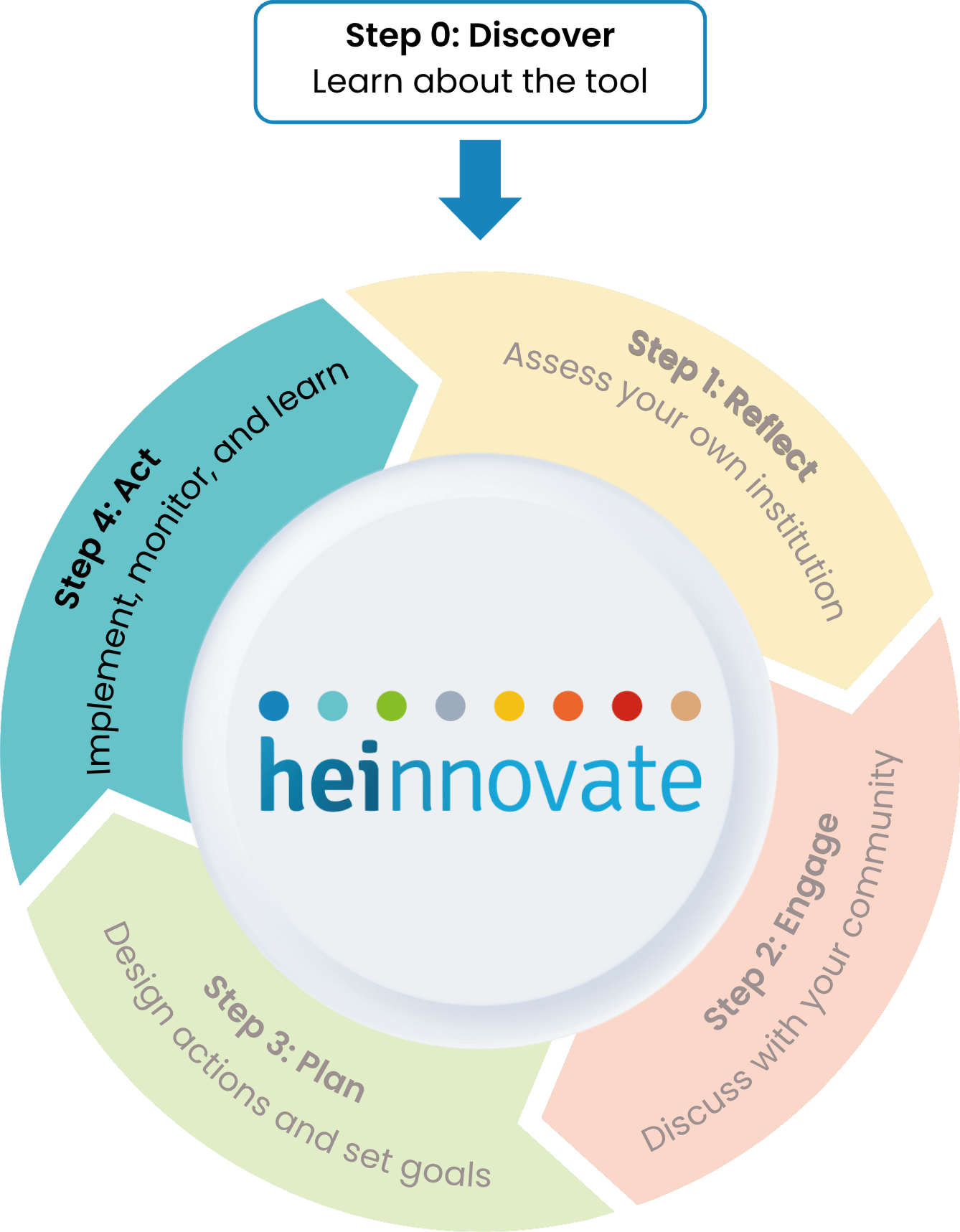
The steps below guide you through the features and content of HEInnovate. Click on the carousel to see how to use HEInnovate for an individual or group self-assessment.
Recommended resources:
- HEInnovate Foundation Guide - The starting point for your HEInnovate user journey. The foundation guide offers a practical introduction to HEInnovate, guiding institutions through the full transformation journey from reflection to action
- HEInnovate Transformation Journey for Alliances - A practical guide supporting European Universities alliances in applying HEInnovate collaboratively across partners
- User Stories - See how other institutions have used HEInnovate to guide change
- Description of the 8 Dimensions - Understand the dimensions that HEInnovate assesses
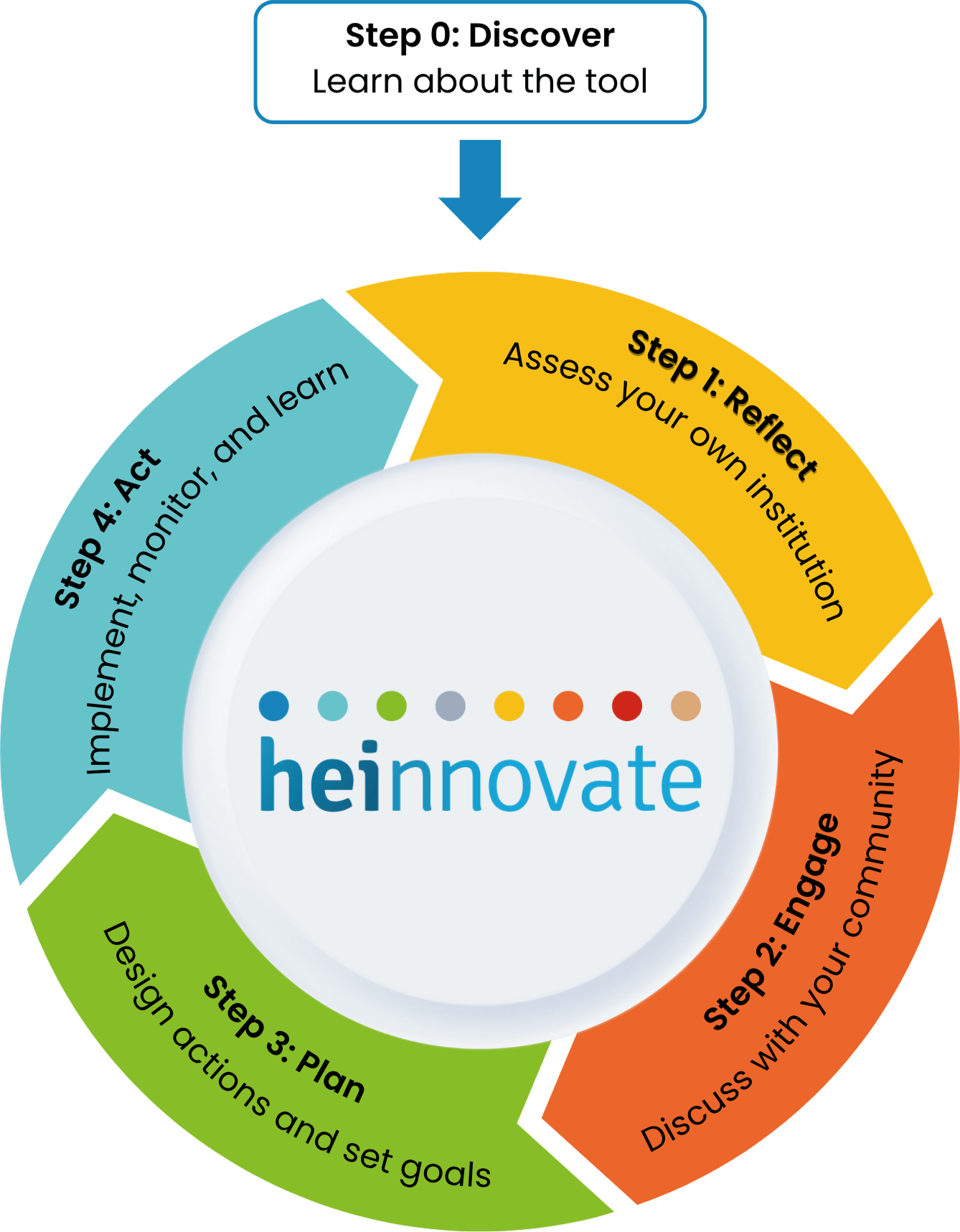
Recommended resources:
- Quick Start Guide: Self-Assessment - Step-by-step guidance for completing the HEInnovate self-assessment as an individual, group participant or organiser
- Start your self-assessment - This is the direct link to start your HEInnovate self-assessment
- Guidance Note - Get detailed interpretations of each statement you will assess
- Description of the 8 Dimensions - Understand the dimensions that HEInnovate assesses
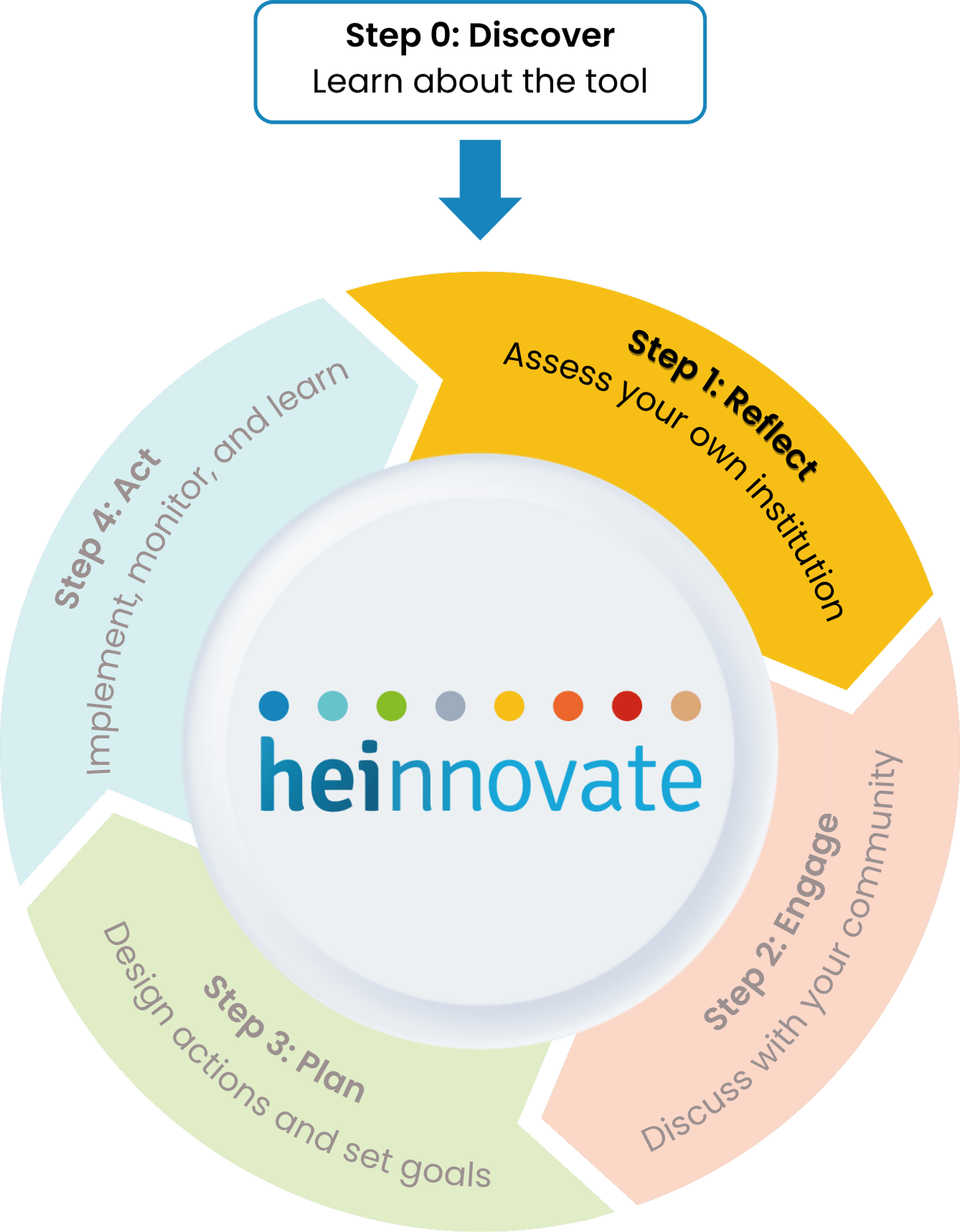
Recommended resources:
- Workshop Guide - Ready-to-use materials for group sessions
- HEInnovate SWOT Analysis - Identify your institution’s strengths, weaknesses, opportunities and threats to define strategic priorities and guide your next steps
- Stakeholder Engagement Toolkit - Practical tools to identify, map and engage key stakeholders throughout the HEInnovate journey.
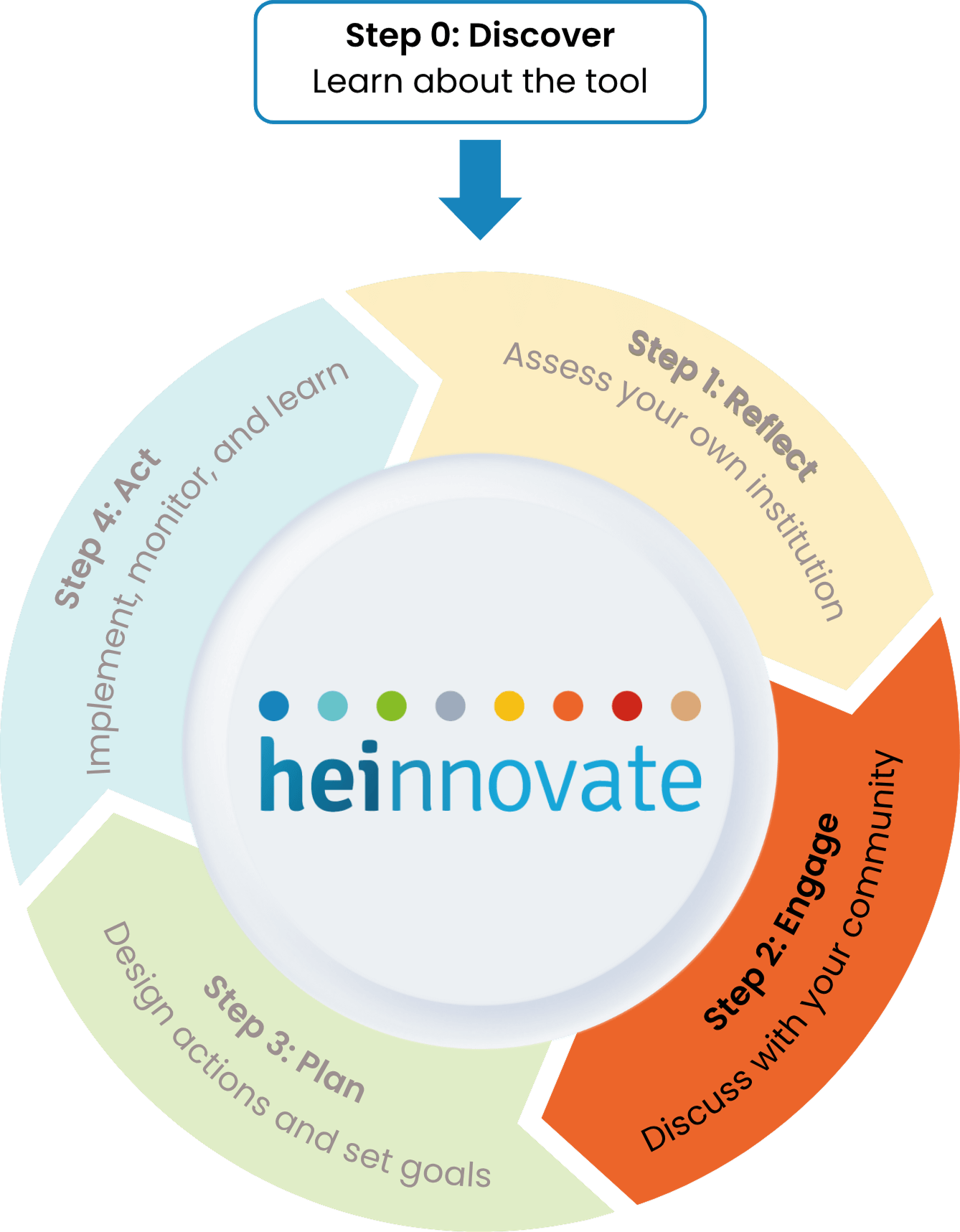
Recommended resources:
- Workshop Guide - Ready-to-use materials for group sessions
- Action Planning Board – Dimensions - Visual tool for mapping short-, medium-, and long-term actions
- Work Package Planning Board - Template to cluster and organise activities for implementation
- Instruction: HEInnovate Action Planning Board and Work Package Planning Board - Learn how to use the planning boards to turn assessment results into concrete actions and structure their implementation
- Action Cards - Tailored recommendations and inspiration linked to the 8 dimensions
- Case Studies - Discover good practices in innovation and entrepreneurship across the 8 dimensions
- User Stories - See how other institutions have used HEInnovate to guide change
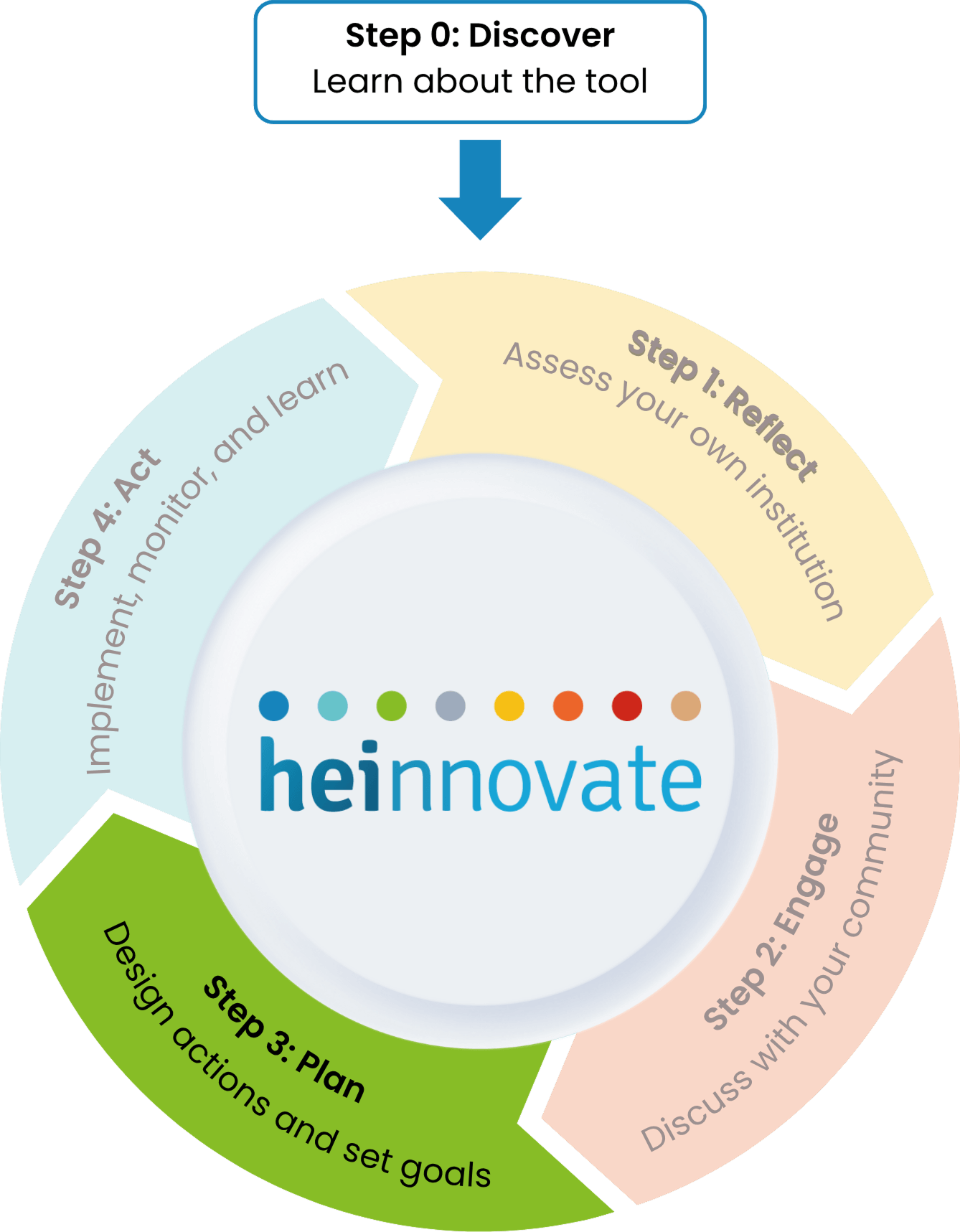
Now, put your plans into motion. Launch new initiatives, strengthen collaboration, and build capacity for entrepreneurship and innovation across your institution.
You can also use your HEInnovate Action Plan as the foundation for an Innovation Vision Action Plan (IVAP). This is eligible for EIT Higher Education Initiative (EIT HEI) funding, which offers access to European partnerships and networks.
Remember — transformation is ongoing. Revisit HEInnovate regularly to repeat the self-assessment, reflect on progress, and update your action plan for continuous improvement.
Recommended resources:
- Repeat your self-assessment - This is the direct link to start your HEInnovate self-assessment
- Case Studies - Discover good practices in innovation and entrepreneurship across the 8 dimensions
- Stakeholder Engagement Toolkit - Practical tools to identify, map and engage key stakeholders throughout the HEInnovate journey
Recommended resources:
- HEInnovate Foundation Guide - The starting point for your HEInnovate user journey. The foundation guide offers a practical introduction to HEInnovate, guiding institutions through the full transformation journey from reflection to action
- HEInnovate Transformation Journey for Alliances - A practical guide supporting European Universities alliances in applying HEInnovate collaboratively across partners
- User Stories - See how other institutions have used HEInnovate to guide change
- Description of the 8 Dimensions - Understand the dimensions that HEInnovate assesses
Recommended resources:
- Quick Start Guide: Self-Assessment - Step-by-step guidance for completing the HEInnovate self-assessment as an individual, group participant or organiser
- Start your self-assessment - This is the direct link to start your HEInnovate self-assessment
- Guidance Note - Get detailed interpretations of each statement you will assess
- Description of the 8 Dimensions - Understand the dimensions that HEInnovate assesses
Recommended resources:
- Workshop Guide - Ready-to-use materials for group sessions
- HEInnovate SWOT Analysis - Identify your institution’s strengths, weaknesses, opportunities and threats to define strategic priorities and guide your next steps
- Stakeholder Engagement Toolkit - Practical tools to identify, map and engage key stakeholders throughout the HEInnovate journey.
Recommended resources:
- Workshop Guide - Ready-to-use materials for group sessions
- Action Planning Board – Dimensions - Visual tool for mapping short-, medium-, and long-term actions
- Work Package Planning Board - Template to cluster and organise activities for implementation
- Instruction: HEInnovate Action Planning Board and Work Package Planning Board - Learn how to use the planning boards to turn assessment results into concrete actions and structure their implementation
- Action Cards - Tailored recommendations and inspiration linked to the 8 dimensions
- Case Studies - Discover good practices in innovation and entrepreneurship across the 8 dimensions
- User Stories - See how other institutions have used HEInnovate to guide change
Now, put your plans into motion. Launch new initiatives, strengthen collaboration, and build capacity for entrepreneurship and innovation across your institution.
You can also use your HEInnovate Action Plan as the foundation for an Innovation Vision Action Plan (IVAP). This is eligible for EIT Higher Education Initiative (EIT HEI) funding, which offers access to European partnerships and networks.
Remember — transformation is ongoing. Revisit HEInnovate regularly to repeat the self-assessment, reflect on progress, and update your action plan for continuous improvement.
Recommended resources:
- Repeat your self-assessment - This is the direct link to start your HEInnovate self-assessment
- Case Studies - Discover good practices in innovation and entrepreneurship across the 8 dimensions
- Stakeholder Engagement Toolkit - Practical tools to identify, map and engage key stakeholders throughout the HEInnovate journey
All resources
- Case studies
- Contains controls to share this content on social networks or by email.Share this page
Milan Polytechnic University (Polimi) is the largest Italian technical university. Its primary purpose is to provide students with solid technical competences. Recent studies on student entrepreneurship at Polimi have shown that the technical competences of Polimi alumni frequently generate new business ideas that often lead to start-ups. Thus, the...
- Case studies
- Contains controls to share this content on social networks or by email.Share this page
University of Aveiro (UA) is a young innovative university that was founded in 1973 and soon after assumed the leadership in the teaching/learning and research in technical areas. The focus is on science and technology, particularly applied research that lends itself to technology transfer into the region. The university’s strap line is "Um Campus...
- Guidance notes
- Contains controls to share this content on social networks or by email.Share this page
An international or global perspective is a key characteristic of an entrepreneurial and innovative HEI. Most institutions have internationalisation strategies, or internationalisation is reflected in their overarching strategy. An entrepreneurial and innovative HEI will harmonise its approach to global, societal and ecological challenges with its...
- Guidance notes
- Contains controls to share this content on social networks or by email.Share this page
Staff are a higher education institution's key resource in advancing the entrepreneurial and innovative agenda. Many areas of the entrepreneurial and innovative agenda – for example entrepreneurship education, knowledge exchange, measuring impact – are fast moving and require new skills and new knowledge to be acquired, shared and developed within...
- Case studies
- Contains controls to share this content on social networks or by email.Share this page
Lund University (LU) is located close to a science park in a region with numerous incubators and start-ups in a rather densely populated area. The University uses its strategic location as a source of competitive advantage by strongly collaborating with local established companies, start-ups, student organisations, support services and incubators...
- Guidance notes
- Contains controls to share this content on social networks or by email.Share this page
Higher education institutions can build and foster an entrepreneurial culture by recruiting and engaging staff that have strong entrepreneurial backgrounds. This can bring in important human resources (knowledge, skills), as well as financial and social resources (access to networks), which are typically not available inside a higher education...
- Case studies
- Contains controls to share this content on social networks or by email.Share this page
Resource paper prepared by Ben Jongbloed (CHEPS, University of Twente) Introduction The University of Twente (UT), based in the east of the Netherlands, was established in the year of 1961. It is a medium-sized university with a strong engineering core, next to a social sciences base. The UT is very much known for its entrepreneurial character...
- Guidance notes
- Contains controls to share this content on social networks or by email.Share this page
All internal and external stakeholders have a role in supporting an HEI’s entrepreneurial and innovative agenda. An entrepreneurial and innovative HEI understands the value of engaging with multiple external stakeholders to establish synergies. Therefore, it promotes a culture of collaboration within the HEI to build synergies with its...
- Guidance notes
- Contains controls to share this content on social networks or by email.Share this page
Becoming an entrepreneurial and innovative HEI is an incremental and long-term organisational development project, which requires the development of a supportive institutional culture combined with a sustainable and diverse financial base. The ultimate aim of an entrepreneurial HEI is to embed innovation and entrepreneurship into the organisation...
- Guidance notes
- Contains controls to share this content on social networks or by email.Share this page
An innovative HEI should integrate and assimilate the knowledge generated through its activities for extending its entrepreneurial agenda. Linking research and education with industry and local communities can lead to the co-creation of knowledge, for example through the involvement of external partners in teaching and research activities. The...
- Guidance notes
- Contains controls to share this content on social networks or by email.Share this page
Knowledge intensive structures surrounding an HEI provide opportunities to exchange knowledge and ideas and promote a sustainable entrepreneurial ecosystem. These include incubators, science parks and other initiatives. Many knowledge intensive structures, such as incubators and science parks, may be physically close to HEIs, but proximity per se...
- Guidance notes
- Contains controls to share this content on social networks or by email.Share this page
An entrepreneurial and innovative HEI sees the value of engaging with local, regional, national strategy development and implementation as a key stakeholder in local, regional and national socio-economic development. They are often one of the major employers in a locality and their existence will impact on the local economy and social wellbeing...
- Guidance notes
- Contains controls to share this content on social networks or by email.Share this page
Effective collaboration and enhanced synergies with the ecosystem - at local, regional and national levels are crucial for an entrepreneurial and innovative HEI, as it understands the value of engaging with multiple stakeholders to establish synergies. Therefore, it supports innovation to be aligned with the local, national and global challenges...
- Guidance notes
- Contains controls to share this content on social networks or by email.Share this page
The internationalisation of higher education is both a response to and an enhancer of globalisation. Given their unique position as global centres of learning and research, and their key role in developing the leaders of the future, the internationalised entrepreneurial higher education institution, has a pivotal role to play in addressing the...
- Guidance notes
- Contains controls to share this content on social networks or by email.Share this page
Transnational cooperation across an institution’s education and research activities deliveries a broad range of activities, especially if the HEI has a policy in place to mainstream innovative practices and ideas developed in alliances and projects in the whole institution. Strategic research partnerships with European HEIs provide a means to...