
Your HEInnovate User Journey
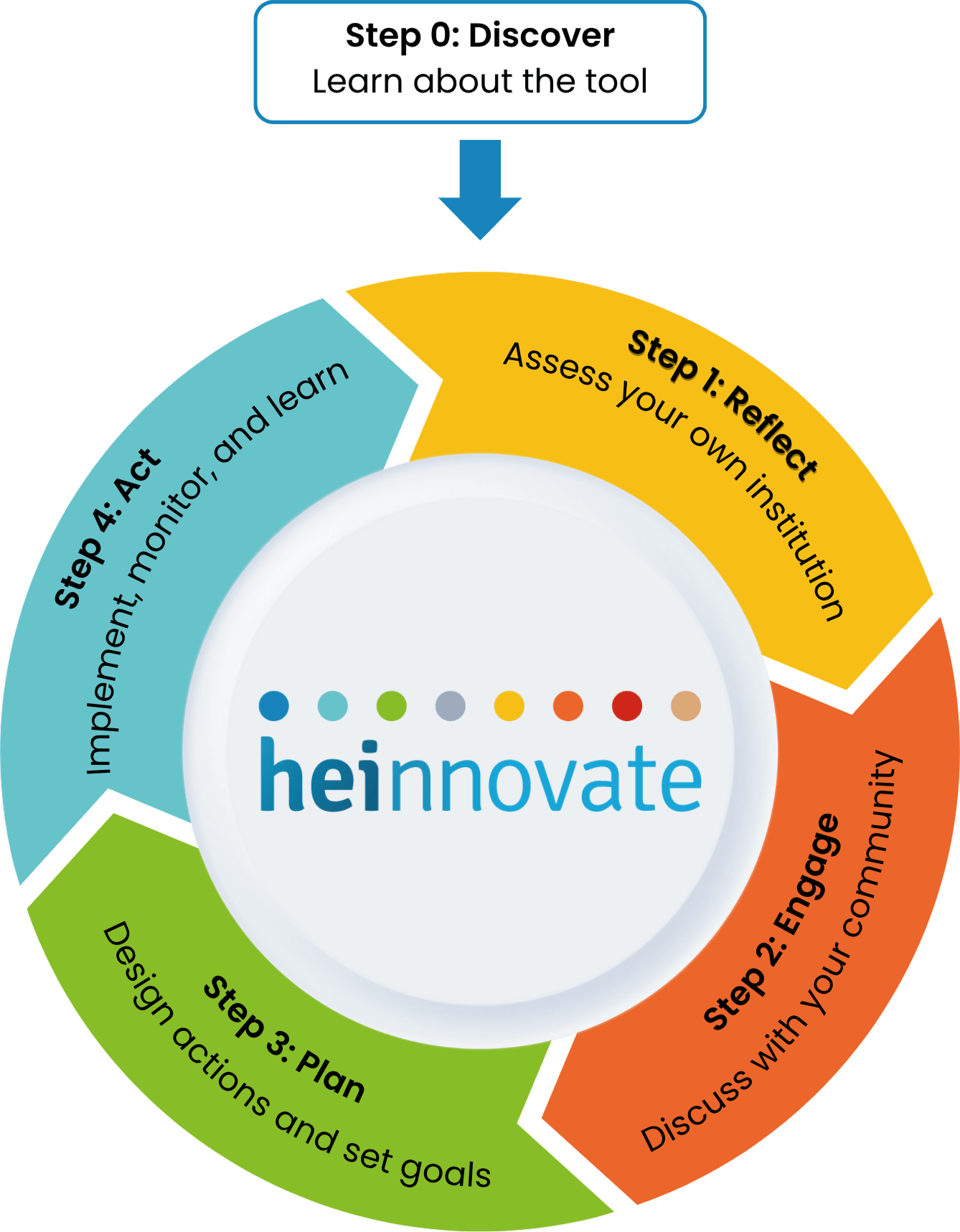
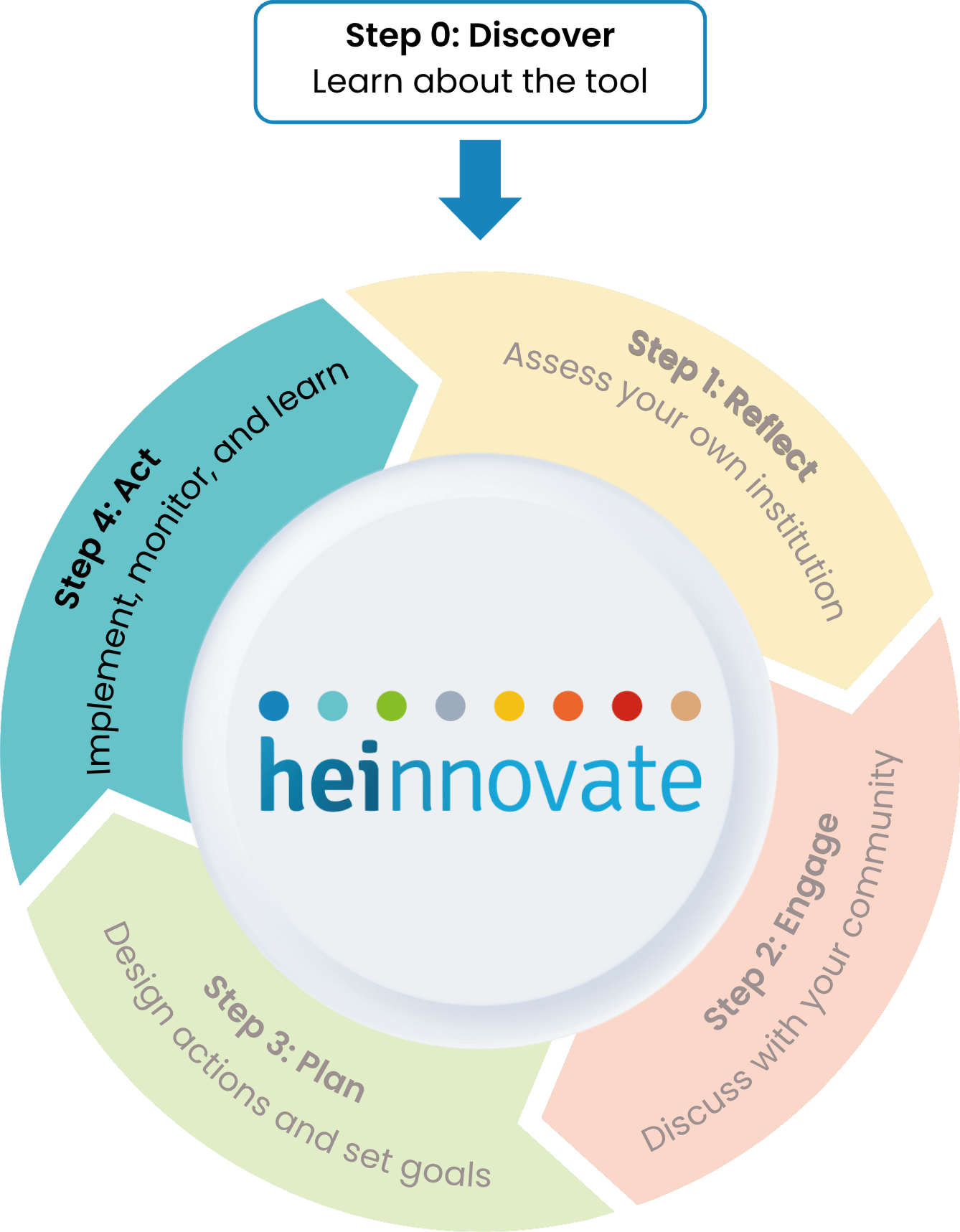
The steps below guide you through the features and content of HEInnovate. Click on the carousel to see how to use HEInnovate for an individual or group self-assessment.
Recommended resources:
- HEInnovate Foundation Guide - The starting point for your HEInnovate user journey. The foundation guide offers a practical introduction to HEInnovate, guiding institutions through the full transformation journey from reflection to action
- HEInnovate Transformation Journey for Alliances - A practical guide supporting European Universities alliances in applying HEInnovate collaboratively across partners
- User Stories - See how other institutions have used HEInnovate to guide change
- Description of the 8 Dimensions - Understand the dimensions that HEInnovate assesses
Recommended resources:
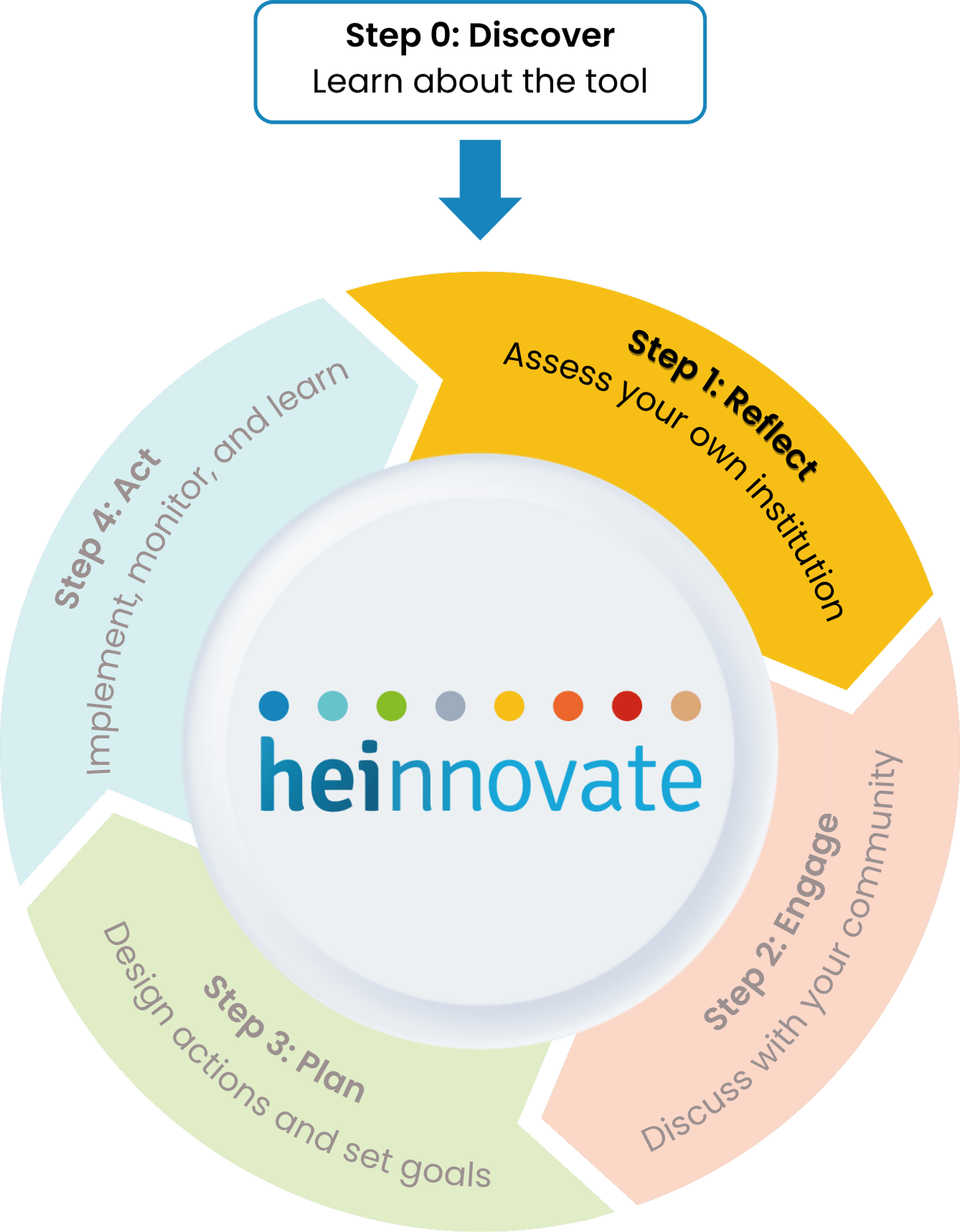
- Quick Start Guide: Self-Assessment - Step-by-step guidance for completing the HEInnovate self-assessment as an individual, group participant or organiser
- Start your self-assessment - This is the direct link to start your HEInnovate self-assessment
- Guidance Note - Get detailed interpretations of each statement you will assess
- Description of the 8 Dimensions - Understand the dimensions that HEInnovate assesses
Recommended resources:
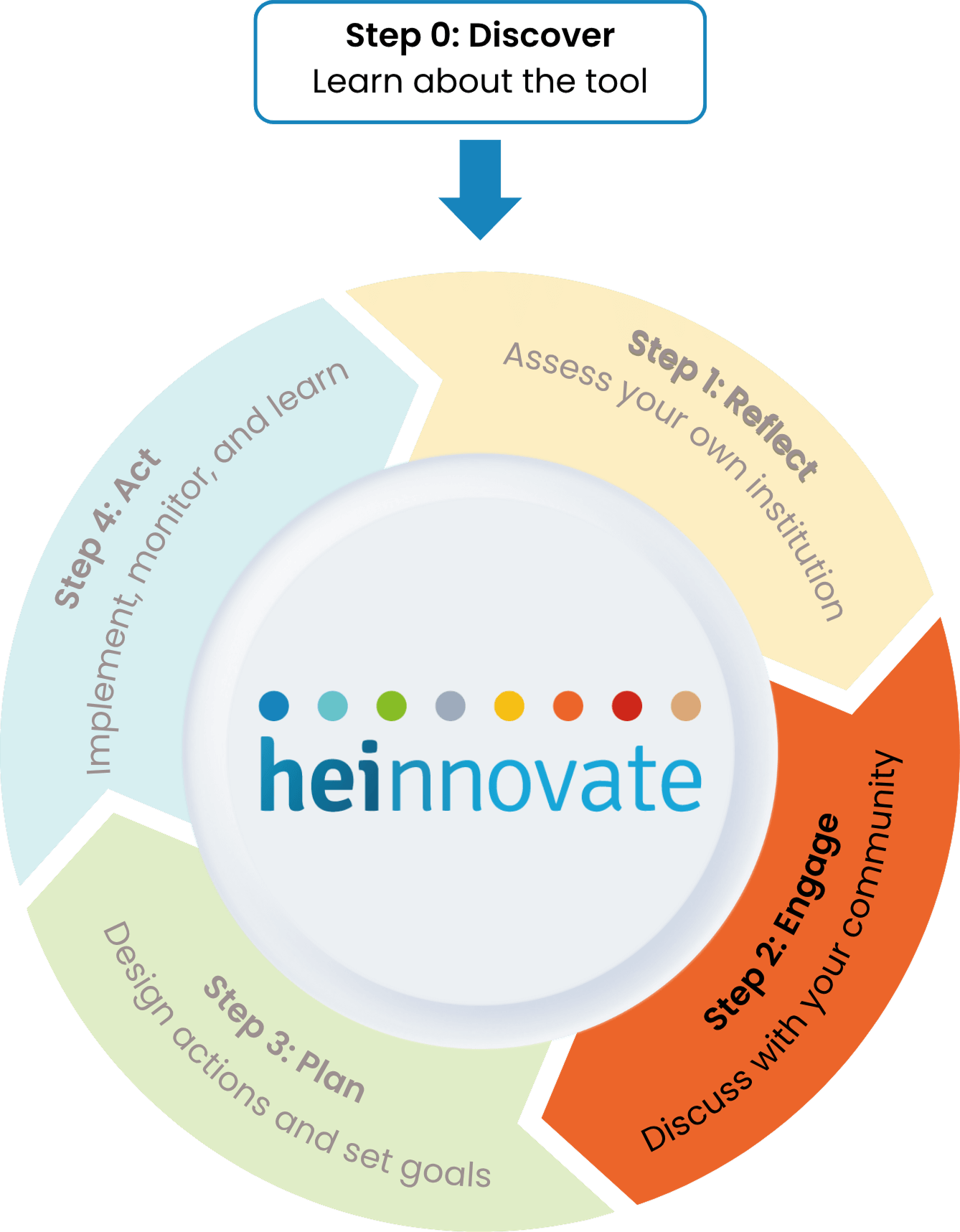
- Workshop Guide - Ready-to-use materials for group sessions
- HEInnovate SWOT Analysis - Identify your institution’s strengths, weaknesses, opportunities and threats to define strategic priorities and guide your next steps
- Stakeholder Engagement Toolkit - Practical tools to identify, map and engage key stakeholders throughout the HEInnovate journey.
Recommended resources:
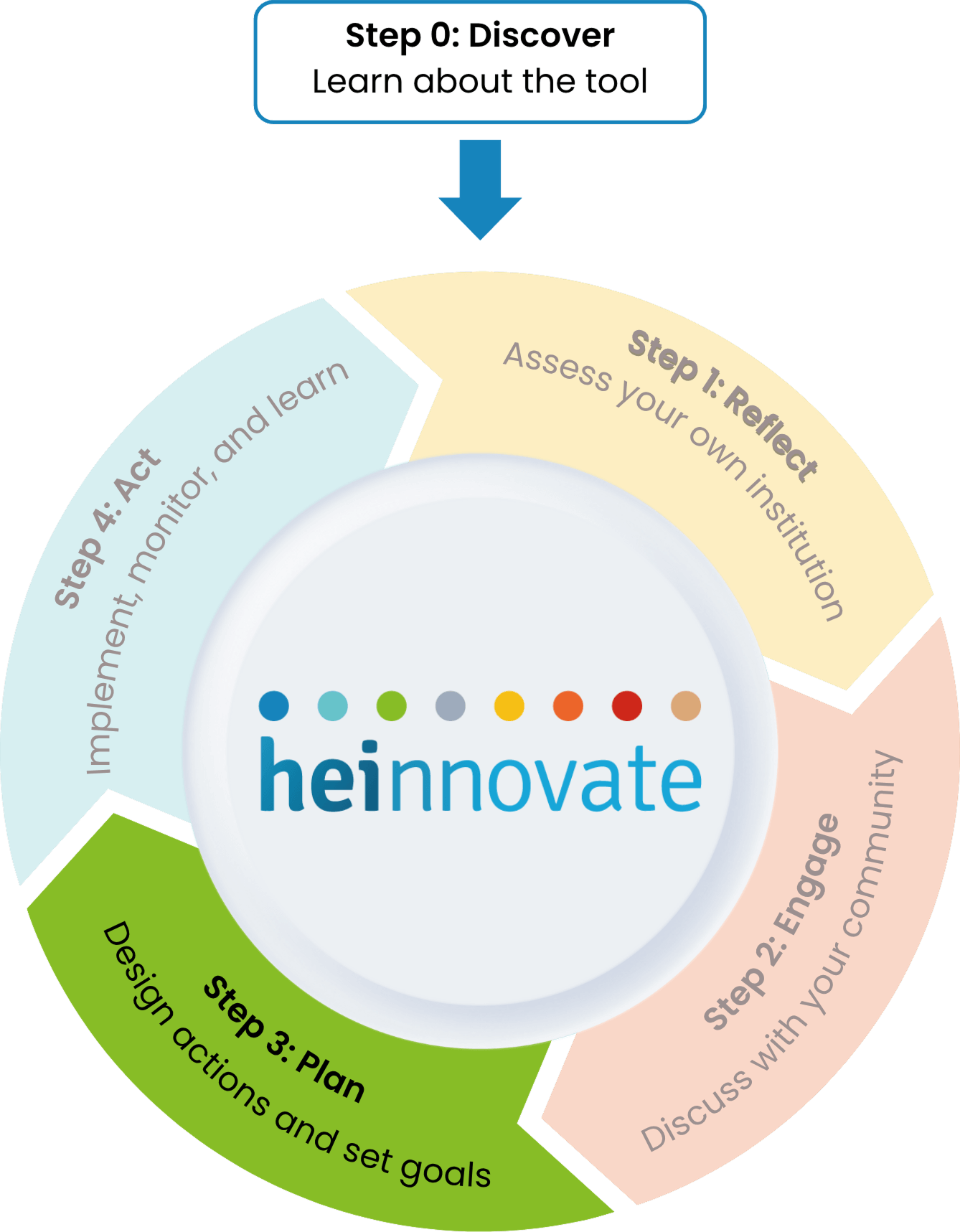
- Workshop Guide - Ready-to-use materials for group sessions
- Action Planning Board – Dimensions - Visual tool for mapping short-, medium-, and long-term actions
- Work Package Planning Board - Template to cluster and organise activities for implementation
- Instruction: HEInnovate Action Planning Board and Work Package Planning Board - Learn how to use the planning boards to turn assessment results into concrete actions and structure their implementation
- Action Cards - Tailored recommendations and inspiration linked to the 8 dimensions
- Case Studies - Discover good practices in innovation and entrepreneurship across the 8 dimensions
- User Stories - See how other institutions have used HEInnovate to guide change
Now, put your plans into motion. Launch new initiatives, strengthen collaboration, and build capacity for entrepreneurship and innovation across your institution.
You can also use your HEInnovate Action Plan as the foundation for an Innovation Vision Action Plan (IVAP). This is eligible for EIT Higher Education Initiative (EIT HEI) funding, which offers access to European partnerships and networks.
Remember — transformation is ongoing. Revisit HEInnovate regularly to repeat the self-assessment, reflect on progress, and update your action plan for continuous improvement.
Recommended resources:
- Repeat your self-assessment - This is the direct link to start your HEInnovate self-assessment
- Case Studies - Discover good practices in innovation and entrepreneurship across the 8 dimensions
- Stakeholder Engagement Toolkit - Practical tools to identify, map and engage key stakeholders throughout the HEInnovate journey
Recommended resources:
- HEInnovate Foundation Guide - The starting point for your HEInnovate user journey. The foundation guide offers a practical introduction to HEInnovate, guiding institutions through the full transformation journey from reflection to action
- HEInnovate Transformation Journey for Alliances - A practical guide supporting European Universities alliances in applying HEInnovate collaboratively across partners
- User Stories - See how other institutions have used HEInnovate to guide change
- Description of the 8 Dimensions - Understand the dimensions that HEInnovate assesses
Recommended resources:
- Quick Start Guide: Self-Assessment - Step-by-step guidance for completing the HEInnovate self-assessment as an individual, group participant or organiser
- Start your self-assessment - This is the direct link to start your HEInnovate self-assessment
- Guidance Note - Get detailed interpretations of each statement you will assess
- Description of the 8 Dimensions - Understand the dimensions that HEInnovate assesses
Recommended resources:
- Workshop Guide - Ready-to-use materials for group sessions
- HEInnovate SWOT Analysis - Identify your institution’s strengths, weaknesses, opportunities and threats to define strategic priorities and guide your next steps
- Stakeholder Engagement Toolkit - Practical tools to identify, map and engage key stakeholders throughout the HEInnovate journey.
Recommended resources:
- Workshop Guide - Ready-to-use materials for group sessions
- Action Planning Board – Dimensions - Visual tool for mapping short-, medium-, and long-term actions
- Work Package Planning Board - Template to cluster and organise activities for implementation
- Instruction: HEInnovate Action Planning Board and Work Package Planning Board - Learn how to use the planning boards to turn assessment results into concrete actions and structure their implementation
- Action Cards - Tailored recommendations and inspiration linked to the 8 dimensions
- Case Studies - Discover good practices in innovation and entrepreneurship across the 8 dimensions
- User Stories - See how other institutions have used HEInnovate to guide change
Now, put your plans into motion. Launch new initiatives, strengthen collaboration, and build capacity for entrepreneurship and innovation across your institution.
You can also use your HEInnovate Action Plan as the foundation for an Innovation Vision Action Plan (IVAP). This is eligible for EIT Higher Education Initiative (EIT HEI) funding, which offers access to European partnerships and networks.
Remember — transformation is ongoing. Revisit HEInnovate regularly to repeat the self-assessment, reflect on progress, and update your action plan for continuous improvement.
Recommended resources:
- Repeat your self-assessment - This is the direct link to start your HEInnovate self-assessment
- Case Studies - Discover good practices in innovation and entrepreneurship across the 8 dimensions
- Stakeholder Engagement Toolkit - Practical tools to identify, map and engage key stakeholders throughout the HEInnovate journey
All resources
- Case studies
- Contains controls to share this content on social networks or by email.Share this page
The Autonomous University of Barcelona (Universitat Autònoma de Barcelona, UAB), founded in 1968, is one of seven higher education institutions located in the metropolitan area of Barcelona. It is centred in the heart of Catalonia, one of Spain’s most dynamic and entrepreneurial regions. UAB is one of the top three universities in Spain. It is a...
- Case studies
- Contains controls to share this content on social networks or by email.Share this page
The Rovira i Virgili University (URV) was founded in 1992. It is a public university serving southern Catalonia, a region with 800,000 inhabitants. The university was founded by the Catalan Parliament to unite existing higher education faculties and schools in the Tarragona area under a joint institutional umbrella. URV is accountable to the...
- Case studies
- Contains controls to share this content on social networks or by email.Share this page
The Autonomous University of Barcelona (Universitat Autònoma de Barcelona, UAB), founded in 1968, is one of seven higher education institutions located in the metropolitan area of Barcelona. It is centred in the heart of Catalonia, one of Spain’s most dynamic and entrepreneurial regions. UAB is one of the top three universities in Spain. It is a...
- Case studies
- Contains controls to share this content on social networks or by email.Share this page
1. Introduction Aalborg University (AAU) was founded in 1974 from a merger of several well-established higher education institutions with roots going back to the late 18th century. With just 3,000 students enrolled initially, AAU grew to approximately 20,000 students. Students can choose from more than 100 study programmes, at bachelor, master and...
- Case studies
- Contains controls to share this content on social networks or by email.Share this page
Aalborg University (AAU) was founded in 1974 from a merger of several well-established higher education institutions with roots going back to the late 18th century. From initially 3 000 students, AAU grew to approximately 16 000 students, who can choose from more than hundred study programmes, at bachelor, master and doctorate levels, and three...
- Case studies
- Contains controls to share this content on social networks or by email.Share this page
The Autonomous University of Barcelona (Universitat Autònoma de Barcelona, UAB), founded in 1968, is one of seven higher education institutions located in the metropolitan area of Barcelona.The location of the university in the heart of Catalonia is a significant advantage as it is one of Spain’s most dynamic and entrepreneurial regions. In 2012...
- Case studies
- Contains controls to share this content on social networks or by email.Share this page
This case provides insight into how one university has embedded real business experience into the heart of both their degree programme and the local community, through the creation of a separate trading identity run by students. The Allier University-Institute of Technology (I.U.T. d'Allier), was established in 1968. It has three campuses in the...
- Case studies
- Contains controls to share this content on social networks or by email.Share this page
The Rovira i Virgili University (URV) was founded in 1992. It is a public university serving southern Catalonia, a region with 800,000 inhabitants. The university was founded by the Catalan Parliament to unite existing higher education faculties and schools in the Tarragona area under a joint institutional umbrella. In 2015, URV had an annual...
- Case studies
- Contains controls to share this content on social networks or by email.Share this page
Entrepreneurship education (EE) at the University of Huddersfield (UoH) combines strong profiles in curricula offers, extra-curricular activities and organisational setup. The UoH is one of a few UK universities to offer new venture creation degrees: the UoH’s Business School offers bachelor, masters, and doctoral degrees involving to start an...
- Case studies
- Contains controls to share this content on social networks or by email.Share this page
The University of Southern Denmark (SDU) uses a centralised approach to spread and integrate entrepreneurship education (EE) across its six campuses and its five faculties. SDU’s EE is primarily based on a comprehensive and broad understanding of entrepreneurship in the sense of innovation and value creation. The SDU-annexed IDEA Entrepreneurship...
- Case studies
- Contains controls to share this content on social networks or by email.Share this page
This case shows how the creation of a new centre can be used as a focus for knowledge exchange, innovation and enterprise and be successfully integrated into the working of an established University. The Munich University of Applied Sciences (MUAS) was founded in 1971. It hosts 18 000 students, 475 professors, 750 contracted lecturers and 745...
- Case studies
- Contains controls to share this content on social networks or by email.Share this page
The objective of entrepreneurship education (EE) at the J.J. Strossmayer University in Osijek (SUO), Croatia, is to develop entrepreneurial mindsets and related skills. The curriculum consists of an undergraduate, graduate, a postgraduate and a doctoral programme in entrepreneurship. Key to programme development were the commitment and the personal...
- Case studies
- Contains controls to share this content on social networks or by email.Share this page
The Faculty of Economics of the University of Ljubljana (FELU) offers courses on undergraduate, graduate and MBA level in entrepreneurship education (EE), including specialisations in entrepreneurship. In 2006, FELU introduced the Design Thinking (DT) approach to EE. DT is a human-centred, action-oriented and iterative problemsolving and idea...
- Case studies
- Contains controls to share this content on social networks or by email.Share this page
The main focus in the case study of the University of Cambridge (UC) is set on its Centre for Entrepreneurial Learning (CfEL). CfEL’s mission is to spread the spirit of enterprise and this mission is deeply embedded in its approach to entrepreneurship education. CfEL offers a broad variety of innovative educational programmes, such as the...
- Case studies
- Contains controls to share this content on social networks or by email.Share this page
The Technical University of Kosice (TUKE), Slovakia, is located in Kosice, the main city in Eastern Slovakia and the European Capital of Culture 2013. TUKE is a fully-fledged university with a strong technical tradition. It offers curricular entrepreneurship education mainly through its Faculty of Economics, in particular courses in entrepreneurial...