
Your HEInnovate User Journey
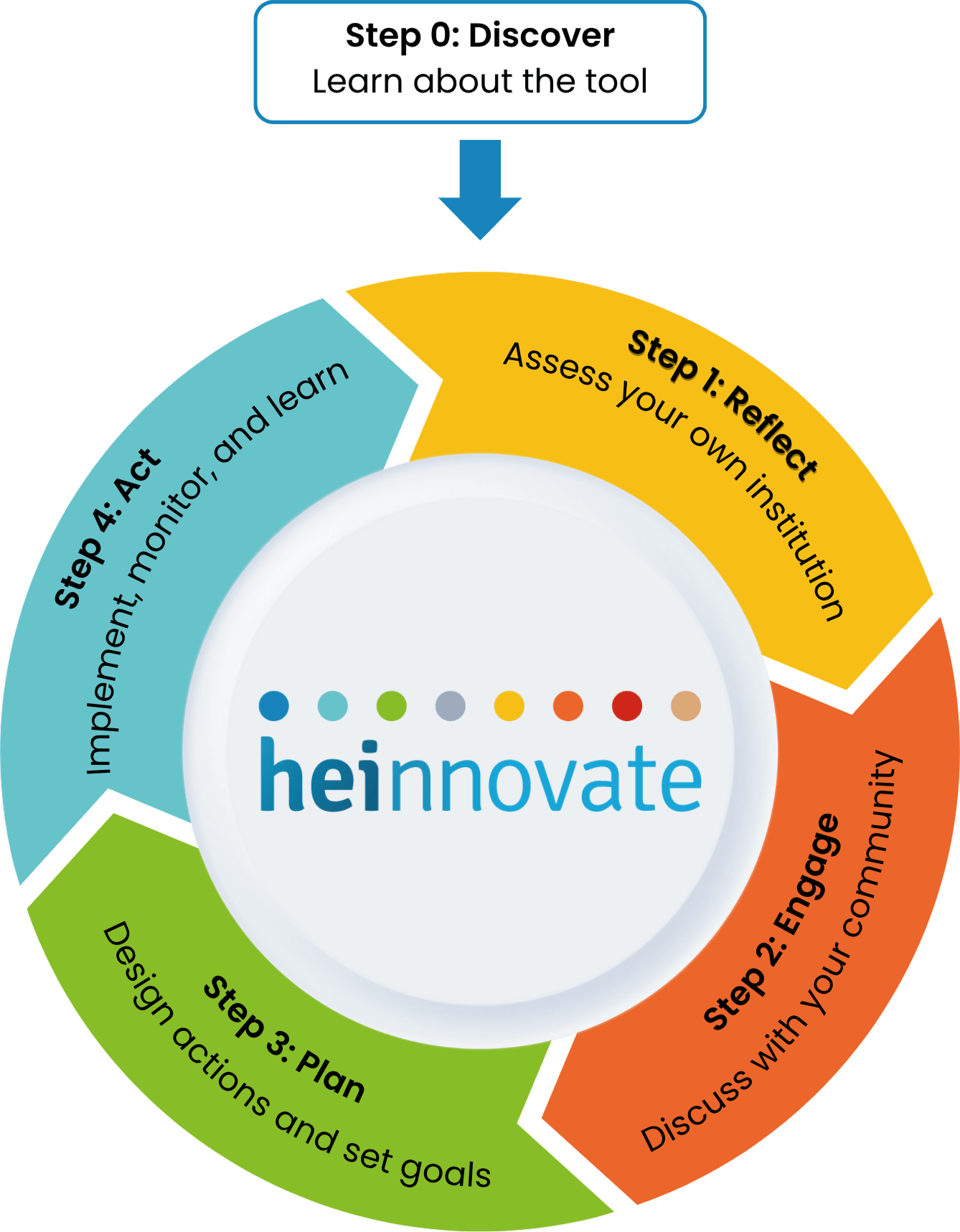
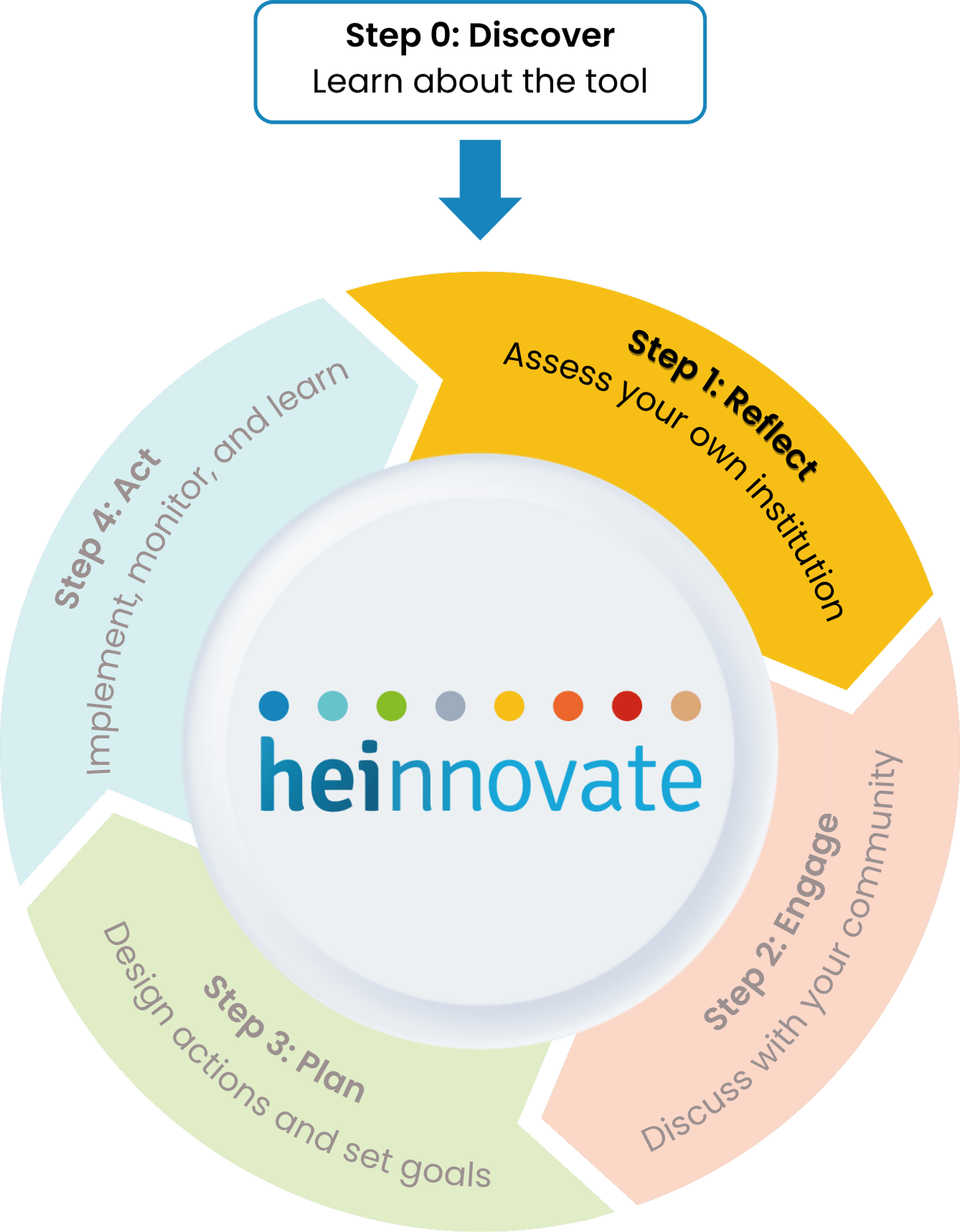
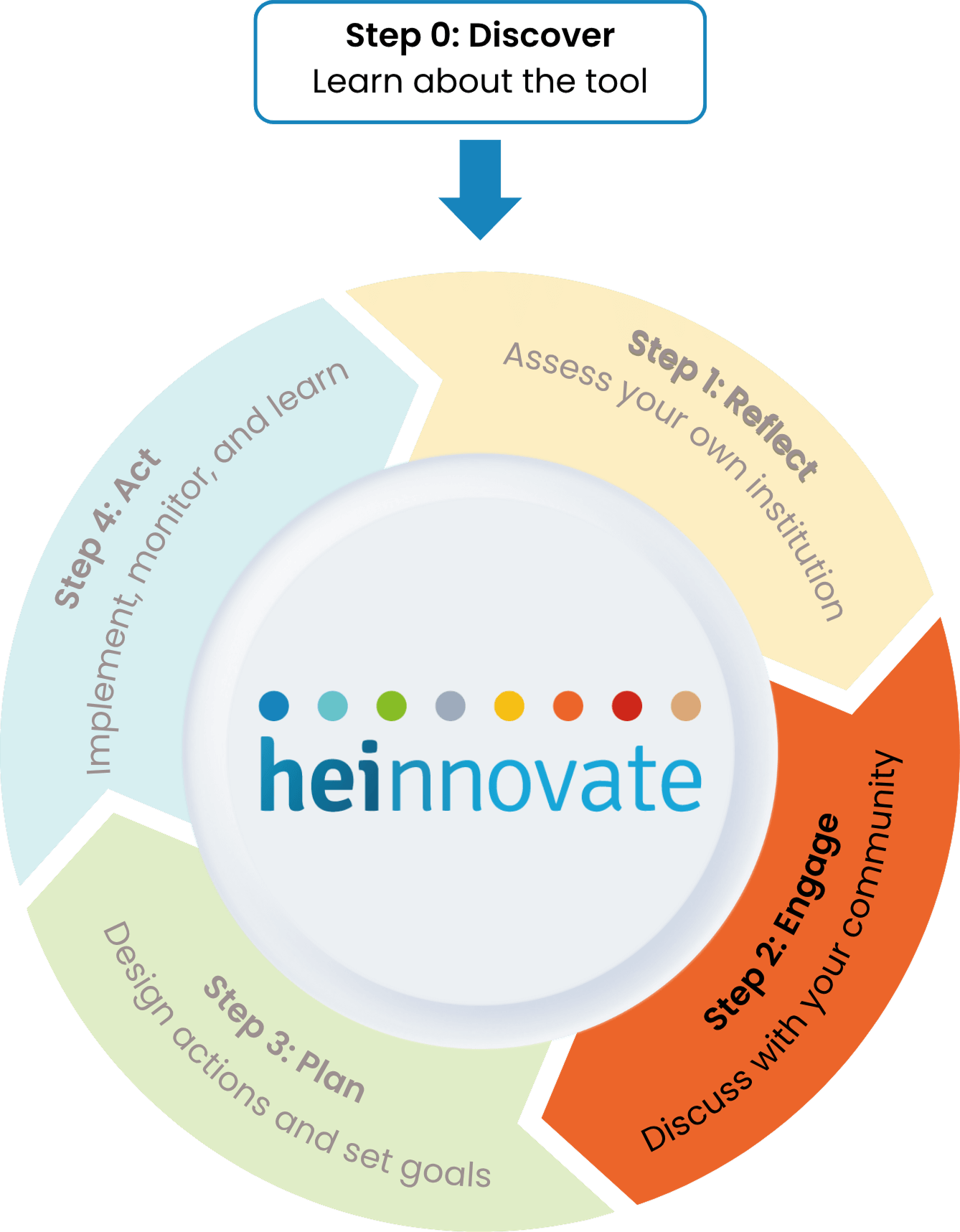
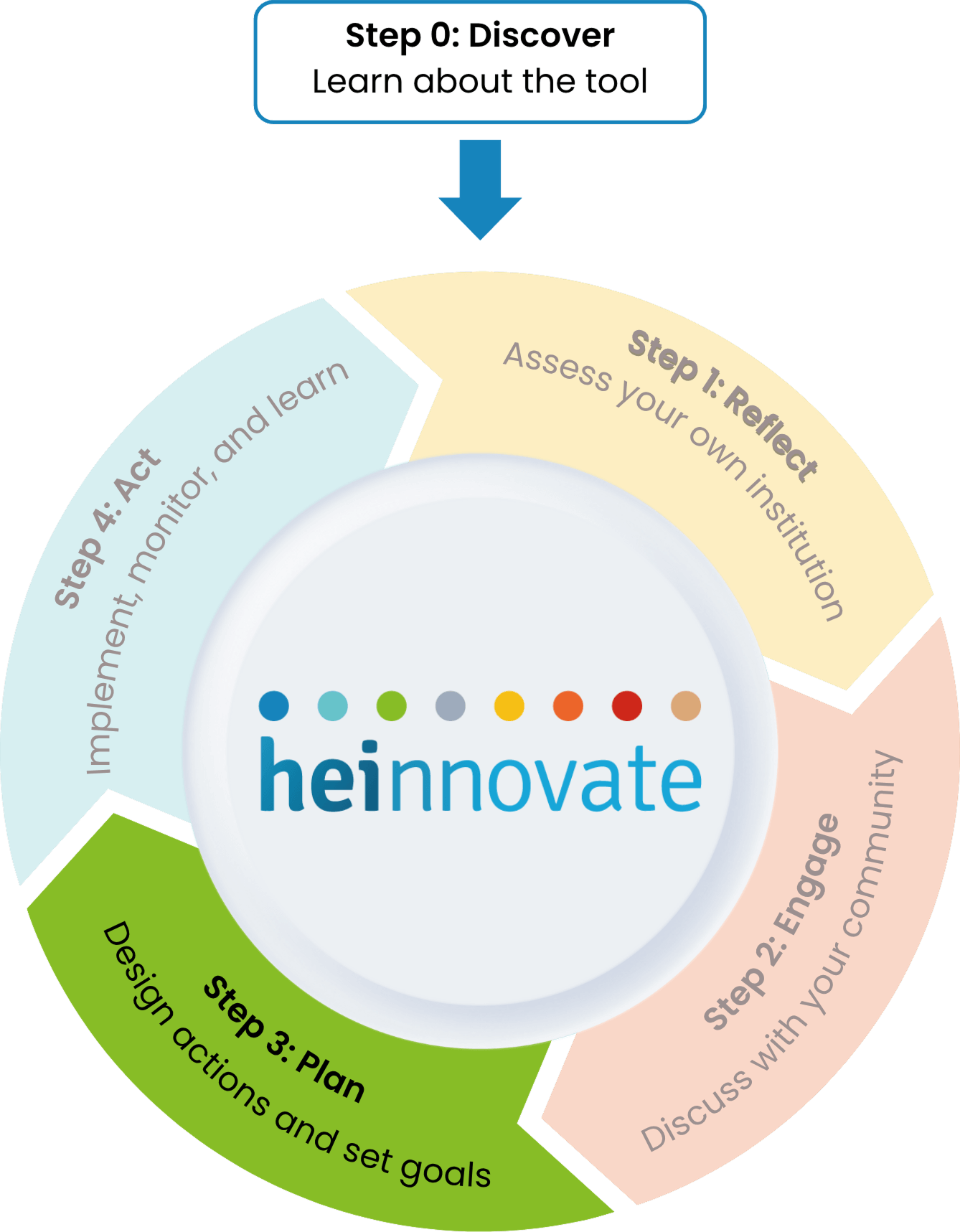
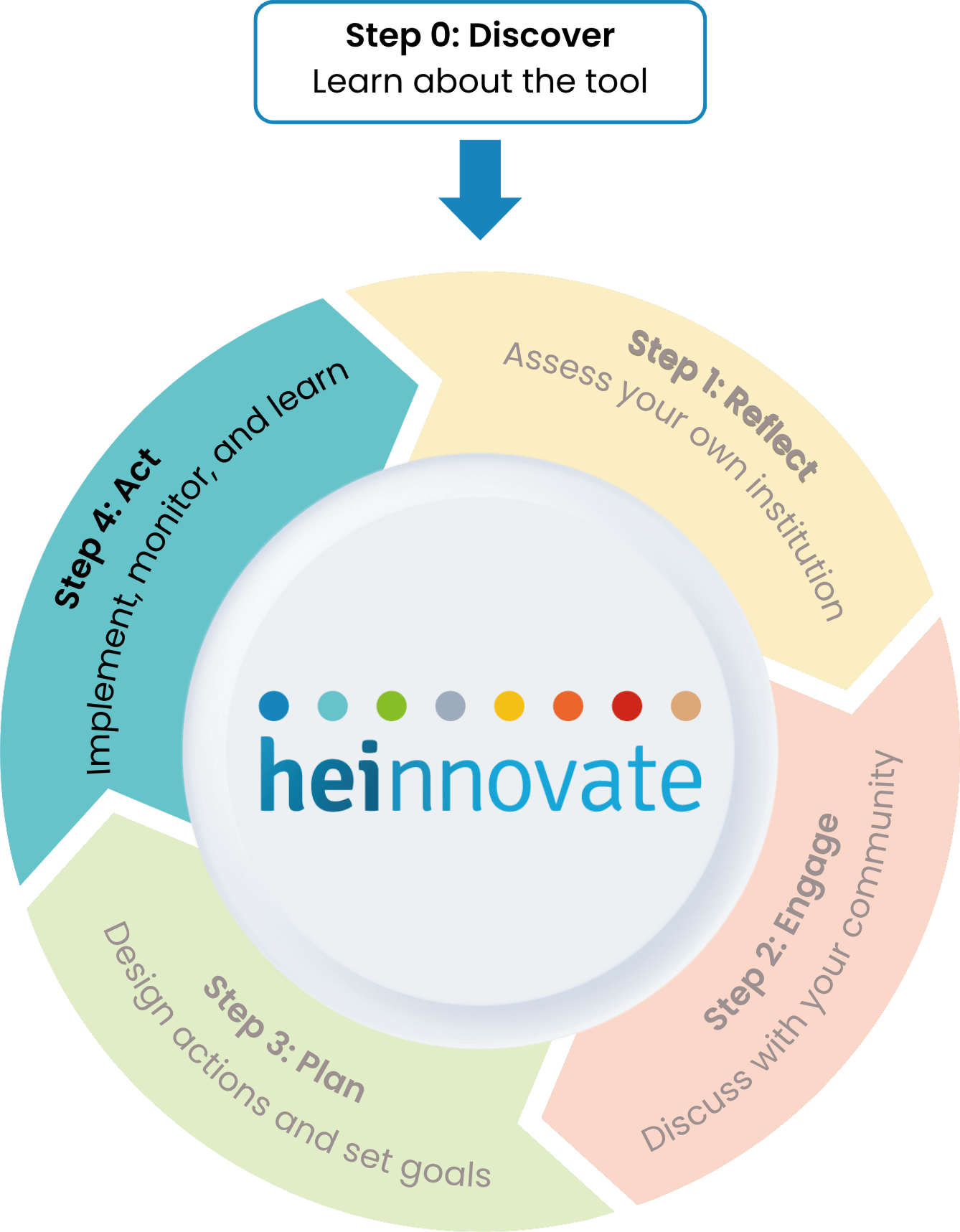
The steps below guide you through the features and content of HEInnovate. Click on the carousel to see how to use HEInnovate for an individual or group self-assessment.
Recommended resources:
- HEInnovate Foundation Guide - The starting point for your HEInnovate user journey. The foundation guide offers a practical introduction to HEInnovate, guiding institutions through the full transformation journey from reflection to action
- HEInnovate Transformation Journey for Alliances - A practical guide supporting European Universities alliances in applying HEInnovate collaboratively across partners
- User Stories - See how other institutions have used HEInnovate to guide change
- Description of the 8 Dimensions - Understand the dimensions that HEInnovate assesses
Recommended resources:
- Quick Start Guide: Self-Assessment - Step-by-step guidance for completing the HEInnovate self-assessment as an individual, group participant or organiser
- Start your self-assessment - This is the direct link to start your HEInnovate self-assessment
- Guidance Note - Get detailed interpretations of each statement you will assess
- Description of the 8 Dimensions - Understand the dimensions that HEInnovate assesses
Recommended resources:
- Workshop Guide - Ready-to-use materials for group sessions
- HEInnovate SWOT Analysis - Identify your institution’s strengths, weaknesses, opportunities and threats to define strategic priorities and guide your next steps
- Stakeholder Engagement Toolkit - Practical tools to identify, map and engage key stakeholders throughout the HEInnovate journey.
Recommended resources:
- Workshop Guide - Ready-to-use materials for group sessions
- Action Planning Board – Dimensions - Visual tool for mapping short-, medium-, and long-term actions
- Work Package Planning Board - Template to cluster and organise activities for implementation
- Instruction: HEInnovate Action Planning Board and Work Package Planning Board - Learn how to use the planning boards to turn assessment results into concrete actions and structure their implementation
- Action Cards - Tailored recommendations and inspiration linked to the 8 dimensions
- Case Studies - Discover good practices in innovation and entrepreneurship across the 8 dimensions
- User Stories - See how other institutions have used HEInnovate to guide change
Now, put your plans into motion. Launch new initiatives, strengthen collaboration, and build capacity for entrepreneurship and innovation across your institution.
You can also use your HEInnovate Action Plan as the foundation for an Innovation Vision Action Plan (IVAP). This is eligible for EIT Higher Education Initiative (EIT HEI) funding, which offers access to European partnerships and networks.
Remember — transformation is ongoing. Revisit HEInnovate regularly to repeat the self-assessment, reflect on progress, and update your action plan for continuous improvement.
Recommended resources:
- Repeat your self-assessment - This is the direct link to start your HEInnovate self-assessment
- Case Studies - Discover good practices in innovation and entrepreneurship across the 8 dimensions
- Stakeholder Engagement Toolkit - Practical tools to identify, map and engage key stakeholders throughout the HEInnovate journey
Recommended resources:
- HEInnovate Foundation Guide - The starting point for your HEInnovate user journey. The foundation guide offers a practical introduction to HEInnovate, guiding institutions through the full transformation journey from reflection to action
- HEInnovate Transformation Journey for Alliances - A practical guide supporting European Universities alliances in applying HEInnovate collaboratively across partners
- User Stories - See how other institutions have used HEInnovate to guide change
- Description of the 8 Dimensions - Understand the dimensions that HEInnovate assesses
Recommended resources:
- Quick Start Guide: Self-Assessment - Step-by-step guidance for completing the HEInnovate self-assessment as an individual, group participant or organiser
- Start your self-assessment - This is the direct link to start your HEInnovate self-assessment
- Guidance Note - Get detailed interpretations of each statement you will assess
- Description of the 8 Dimensions - Understand the dimensions that HEInnovate assesses
Recommended resources:
- Workshop Guide - Ready-to-use materials for group sessions
- HEInnovate SWOT Analysis - Identify your institution’s strengths, weaknesses, opportunities and threats to define strategic priorities and guide your next steps
- Stakeholder Engagement Toolkit - Practical tools to identify, map and engage key stakeholders throughout the HEInnovate journey.
Recommended resources:
- Workshop Guide - Ready-to-use materials for group sessions
- Action Planning Board – Dimensions - Visual tool for mapping short-, medium-, and long-term actions
- Work Package Planning Board - Template to cluster and organise activities for implementation
- Instruction: HEInnovate Action Planning Board and Work Package Planning Board - Learn how to use the planning boards to turn assessment results into concrete actions and structure their implementation
- Action Cards - Tailored recommendations and inspiration linked to the 8 dimensions
- Case Studies - Discover good practices in innovation and entrepreneurship across the 8 dimensions
- User Stories - See how other institutions have used HEInnovate to guide change
Now, put your plans into motion. Launch new initiatives, strengthen collaboration, and build capacity for entrepreneurship and innovation across your institution.
You can also use your HEInnovate Action Plan as the foundation for an Innovation Vision Action Plan (IVAP). This is eligible for EIT Higher Education Initiative (EIT HEI) funding, which offers access to European partnerships and networks.
Remember — transformation is ongoing. Revisit HEInnovate regularly to repeat the self-assessment, reflect on progress, and update your action plan for continuous improvement.
Recommended resources:
- Repeat your self-assessment - This is the direct link to start your HEInnovate self-assessment
- Case Studies - Discover good practices in innovation and entrepreneurship across the 8 dimensions
- Stakeholder Engagement Toolkit - Practical tools to identify, map and engage key stakeholders throughout the HEInnovate journey
All resources
- Case studies
- Contains controls to share this content on social networks or by email.Share this page
This case study shows how one of Ireland’s 14 Institutes of Technology, the Institute of Technology, Tallaght, which brands itself ITT Dublin (ITTD), has established itself as a highly performing institution in respect of knowledge exchange and collaboration with internal staff and students and external commercial and non-commercial stakeholders.
- Country reviews
- Contains controls to share this content on social networks or by email.Share this page
Across Europe and the wider OECD area there are growing signs of a transformation of the 'traditional' model of a university, which focuses its efforts on teaching and research, towards an innovative and entrepreneurial higher education institution(HEI),which is designed to empower students and staff to demonstrate enterprise, innovation and...
- Guidance notes
- Contains controls to share this content on social networks or by email.Share this page
Business incubation and external financing are essential for the success of a new venture. Business incubators and student incubators commonly provide a range of services such as free or subsidised premises, access to laboratories and research facilities, prototyping, IT, secretarial support and networking. They also provide additional services...
- Guidance notes
- Contains controls to share this content on social networks or by email.Share this page
Mentoring and other personal development relationships, such as coaching and tutoring help start-up entrepreneurs identify and overcome problems and develop their business networks. They provide valuable support in the form of knowledge, experience, social capital and encouragement on a long-term basis. These relationships are effective learning...
- Guidance notes
- Contains controls to share this content on social networks or by email.Share this page
An entrepreneurial and innovative HEI supports motivated students, graduates and all types of staff in taking their first steps in preparing for a start-up. This includes developing an idea, finding and building a team, and exploring the technical and market feasibility of a project and introducing staff to new networks. Entrepreneurial and...
- Guidance notes
- Contains controls to share this content on social networks or by email.Share this page
An entrepreneurial and innovative HEI promotes a set of initiatives and funding that inspires and supports academic and professional staff, researchers, graduates and students in linking knowledge with global challenges. Higher education institutions play a pivotal role, in their local communities and the wider ecosystem in supporting and driving...
- Guidance notes
- Contains controls to share this content on social networks or by email.Share this page
Increasing awareness of the value and importance of developing entrepreneurial competences and skills among staff and students is necessary for HEIs to become more entrepreneurial and innovative. A good first step to increasing awareness about support for entrepreneurs available on campus is establishing a central communication mechanism for both...
- Guidance notes
- Contains controls to share this content on social networks or by email.Share this page
Having an understanding of the current impact of the entrepreneurial agenda is just one part of the result. Assessment of impact, particularly where comparisons are made externally, provides learning which should be taken on by the HEI for future improvements. The leadership should be committed to reflecting on the outcomes of the assessment of...
- Guidance notes
- Contains controls to share this content on social networks or by email.Share this page
Entrepreneurial and innovative higher education institutions need to understand the impact of the changes they bring about. The entrepreneurial HEI combines institutional self-perception, external reflection and an evidence-based approach. An HEI that monitors the impact of all activities connected to the entrepreneurial and innovative agenda...
- Guidance notes
- Contains controls to share this content on social networks or by email.Share this page
Comparing priorities, strategies, activities and services with peers (national or international) helps identify strengths and weaknesses for the HEI’s self-improvement. Comparison exercises can be challenging as common indicators need to be in place, otherwise bespoke exercises need to be undertaken which can be costly and time consuming. The...
- Guidance notes
- Contains controls to share this content on social networks or by email.Share this page
Key performance indicators (KPIs) and / or other assessment mechanisms help HEIs monitor and evaluate how well they are performing. An entrepreneurial and innovative institution may wish to combine institutional self-perception, external reflection and an evidence-based approach in its assessment processes. Such methods of assessment might include...
- Guidance notes
- Contains controls to share this content on social networks or by email.Share this page
Incentives and rewards for staff, who actively support the higher education institution in advancing its entrepreneurial agenda are crucial for raising involvement and commitment. Incentives and rewards should be available at an individual level as well as for faculties/departments. Examples include: · Development sabbaticals; · Rewards beyond...
- Case studies
- Contains controls to share this content on social networks or by email.Share this page
The Rovira i Virgili University (URV) was founded in 1992. It is a public university serving southern Catalonia, a region with 800,000 inhabitants. The university was founded by the Catalan Parliament to unite existing higher education faculties and schools in the Tarragona area under a joint institutional umbrella. In 2015, URV had an annual...
- Case studies
- Contains controls to share this content on social networks or by email.Share this page
In 2011, the Genome Canada’s Entrepreneurship Education in Genomics (EEG) pilot programme was set up for a three-year period. The programme provides funding for genomics researchers across Canada to educate the community with respect to creating and adding value to their research and to translate research discoveries into marketable applications...