
Your HEInnovate User Journey
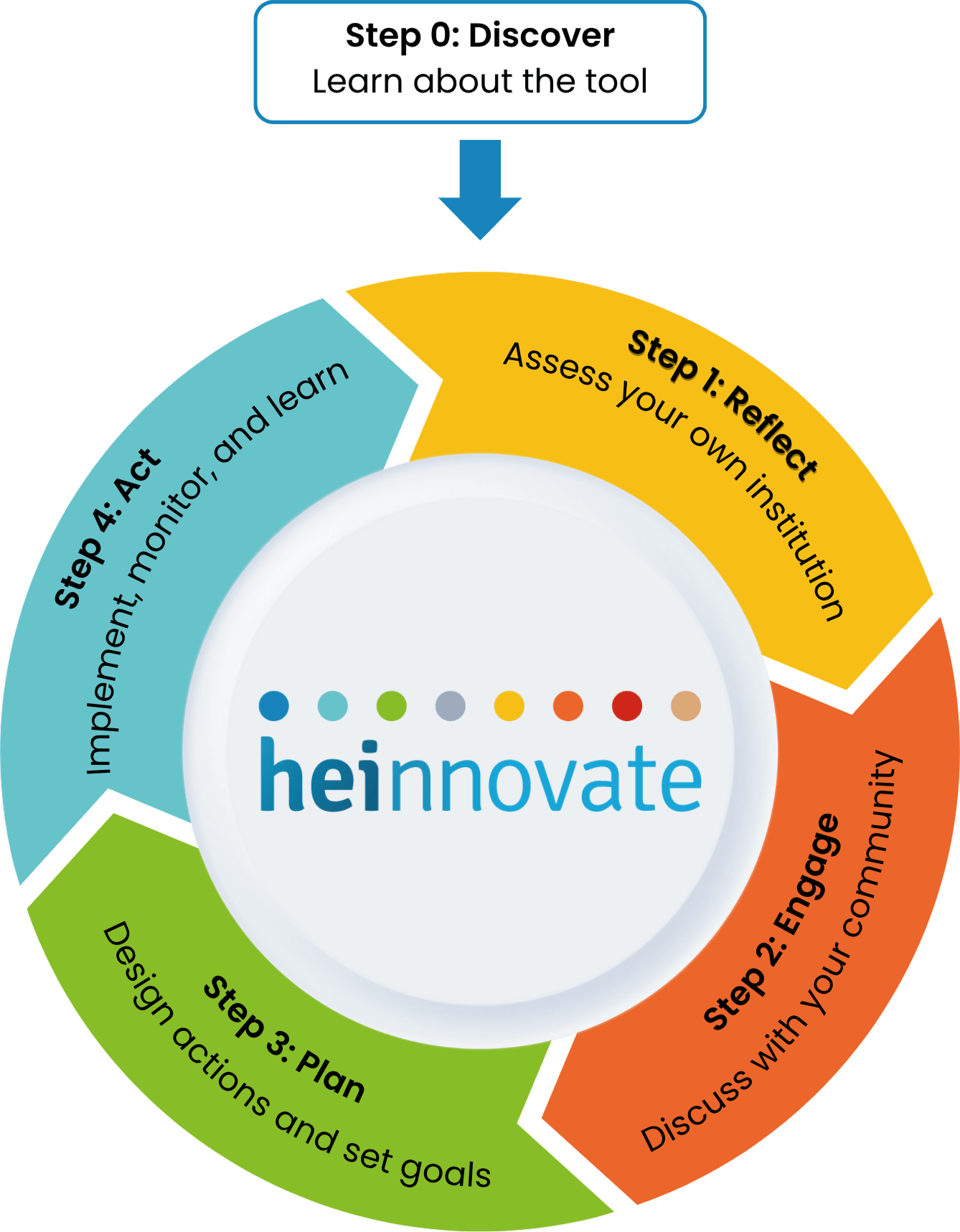
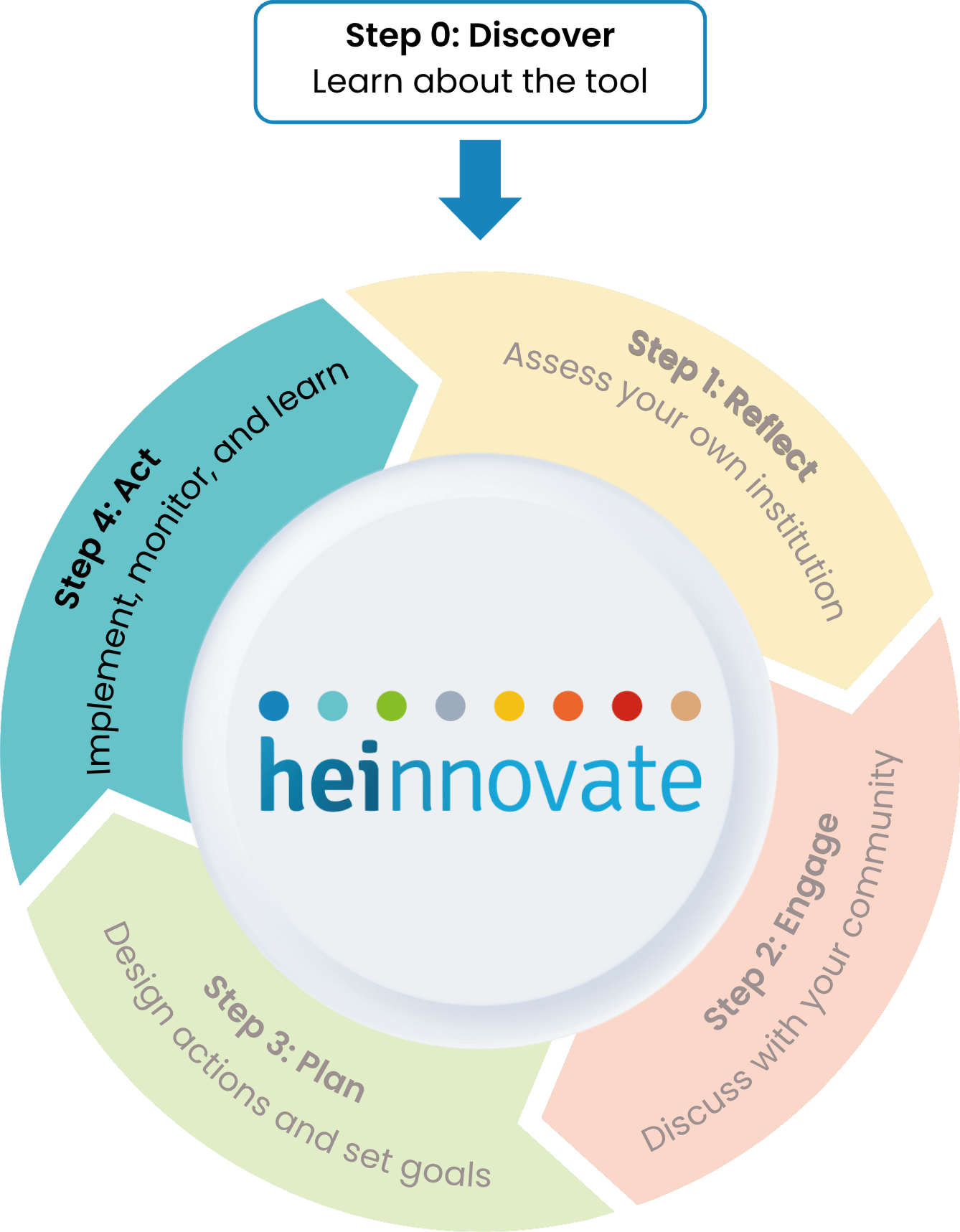
The steps below guide you through the features and content of HEInnovate. Click on the carousel to see how to use HEInnovate for an individual or group self-assessment.
Recommended resources:
- HEInnovate Foundation Guide - The starting point for your HEInnovate user journey. The foundation guide offers a practical introduction to HEInnovate, guiding institutions through the full transformation journey from reflection to action
- HEInnovate Transformation Journey for Alliances - A practical guide supporting European Universities alliances in applying HEInnovate collaboratively across partners
- User Stories - See how other institutions have used HEInnovate to guide change
- Description of the 8 Dimensions - Understand the dimensions that HEInnovate assesses
Recommended resources:
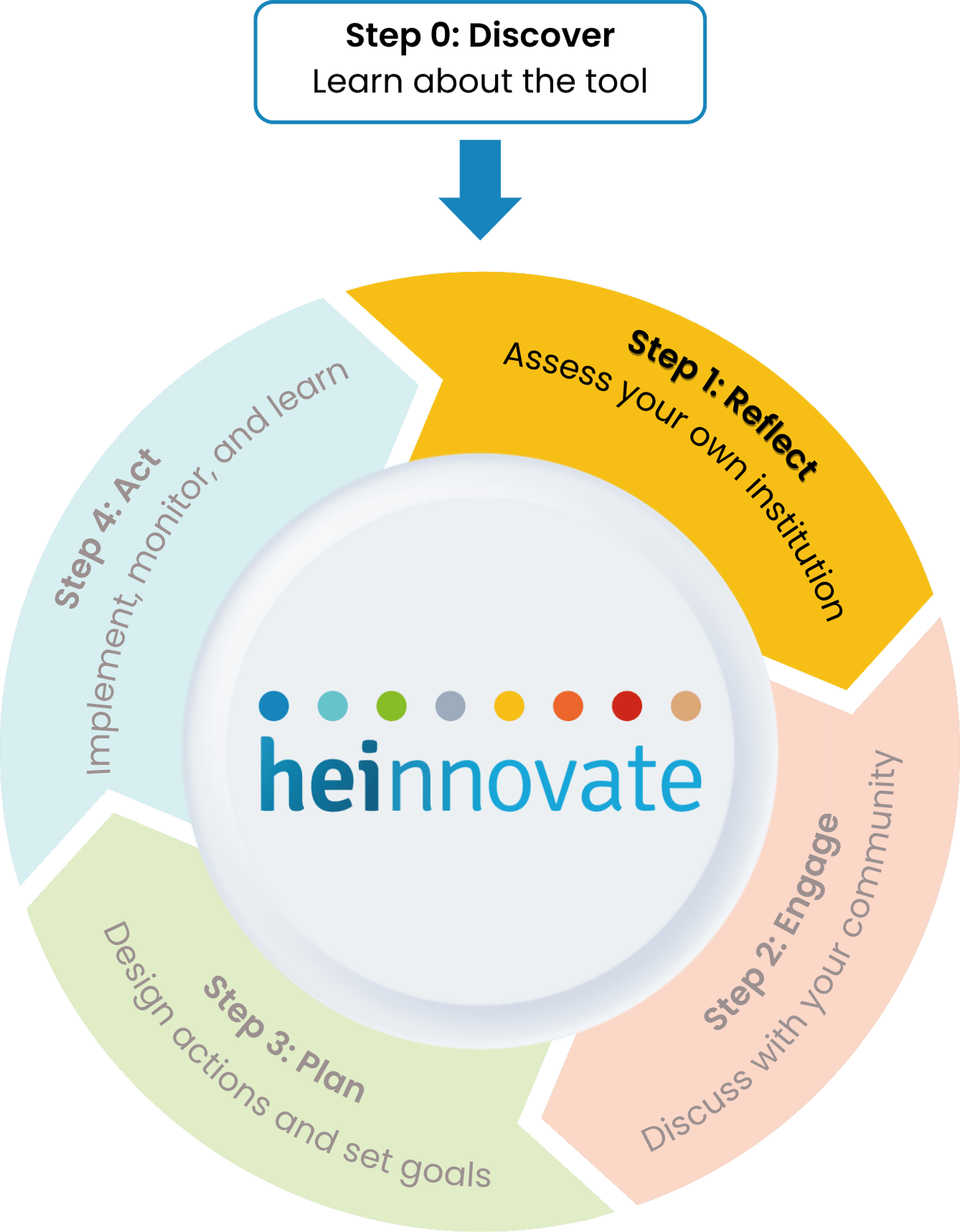
- Quick Start Guide: Self-Assessment - Step-by-step guidance for completing the HEInnovate self-assessment as an individual, group participant or organiser
- Start your self-assessment - This is the direct link to start your HEInnovate self-assessment
- Guidance Note - Get detailed interpretations of each statement you will assess
- Description of the 8 Dimensions - Understand the dimensions that HEInnovate assesses
Recommended resources:
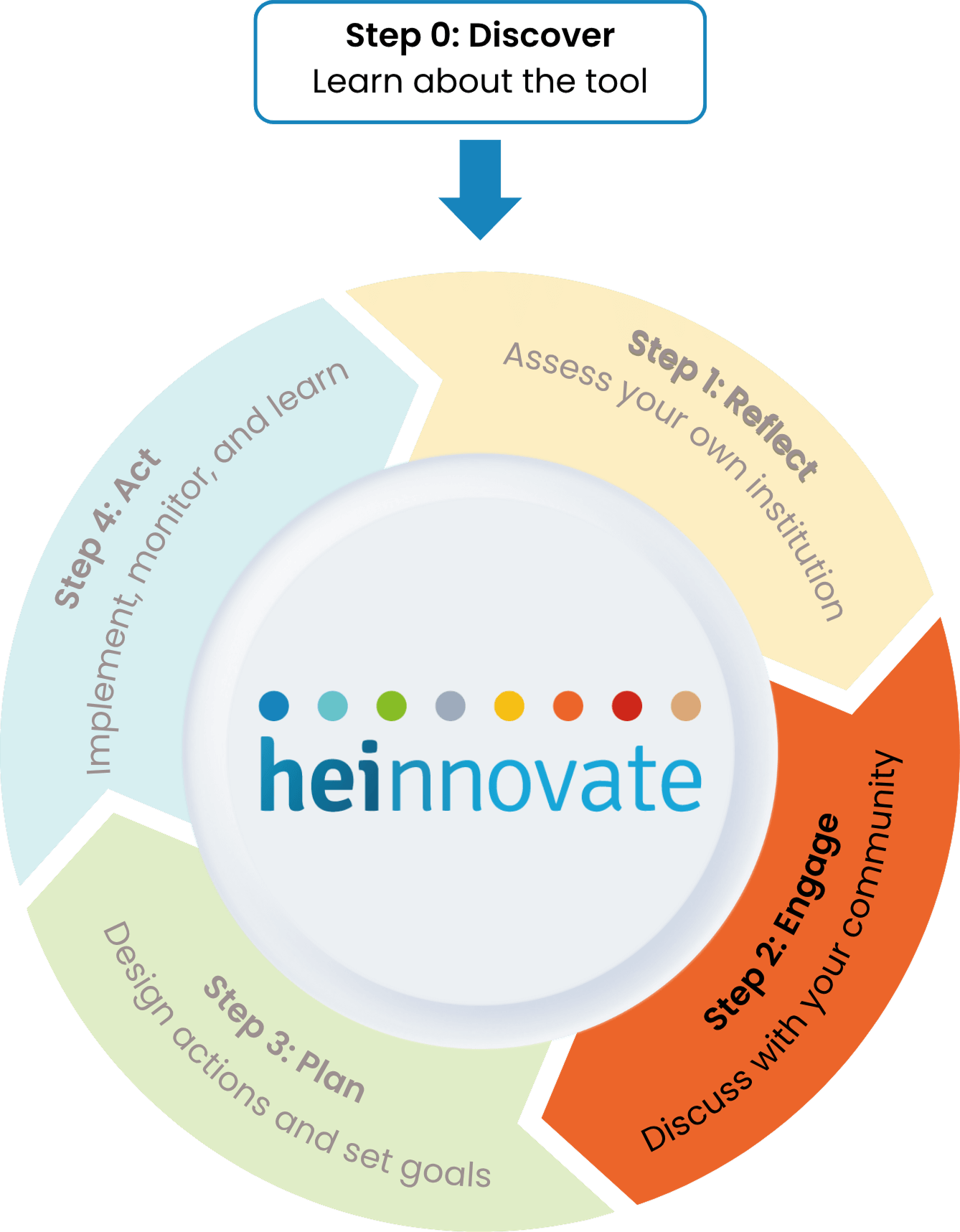
- Workshop Guide - Ready-to-use materials for group sessions
- HEInnovate SWOT Analysis - Identify your institution’s strengths, weaknesses, opportunities and threats to define strategic priorities and guide your next steps
- Stakeholder Engagement Toolkit - Practical tools to identify, map and engage key stakeholders throughout the HEInnovate journey.
Recommended resources:
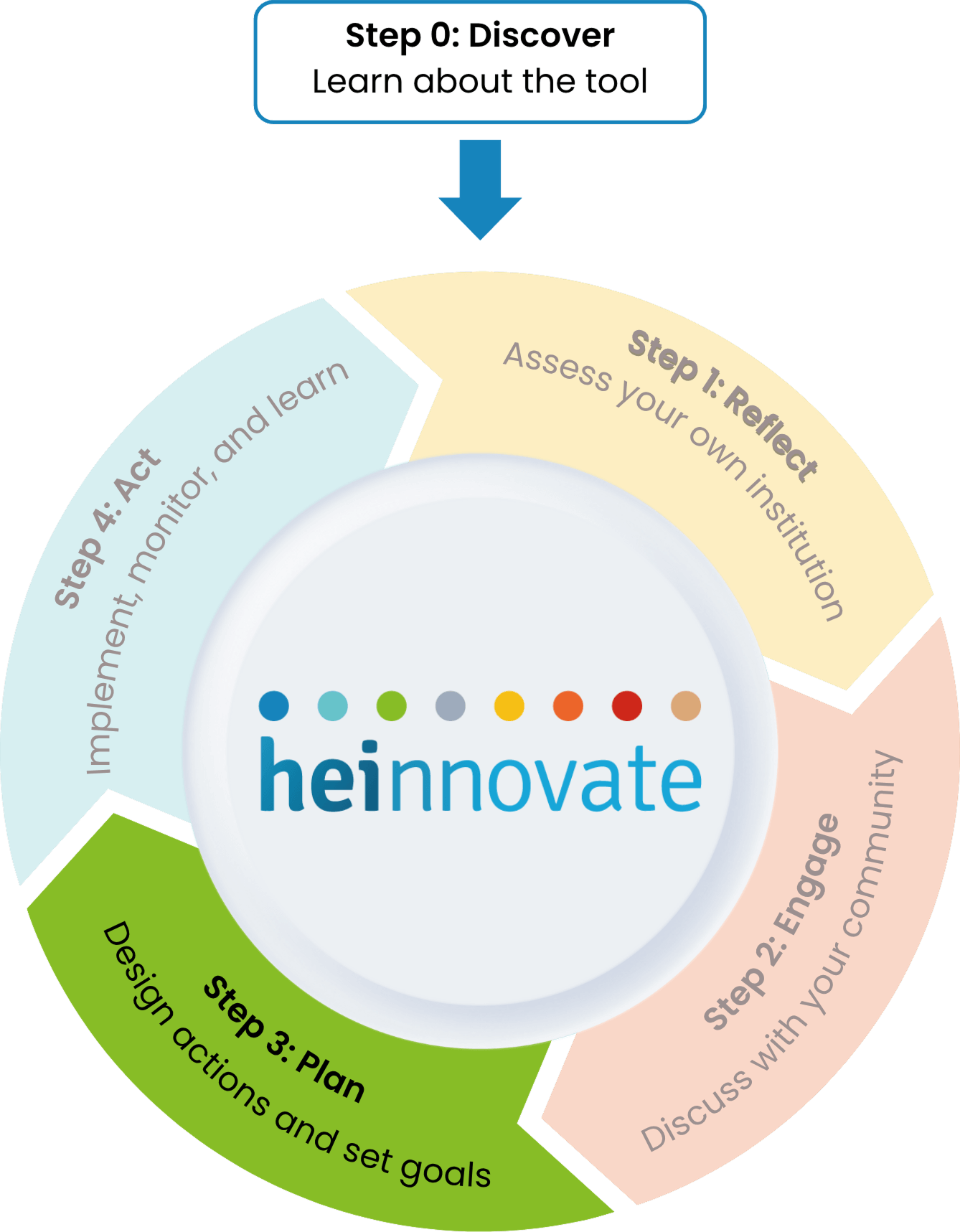
- Workshop Guide - Ready-to-use materials for group sessions
- Action Planning Board – Dimensions - Visual tool for mapping short-, medium-, and long-term actions
- Work Package Planning Board - Template to cluster and organise activities for implementation
- Instruction: HEInnovate Action Planning Board and Work Package Planning Board - Learn how to use the planning boards to turn assessment results into concrete actions and structure their implementation
- Action Cards - Tailored recommendations and inspiration linked to the 8 dimensions
- Case Studies - Discover good practices in innovation and entrepreneurship across the 8 dimensions
- User Stories - See how other institutions have used HEInnovate to guide change
Now, put your plans into motion. Launch new initiatives, strengthen collaboration, and build capacity for entrepreneurship and innovation across your institution.
You can also use your HEInnovate Action Plan as the foundation for an Innovation Vision Action Plan (IVAP). This is eligible for EIT Higher Education Initiative (EIT HEI) funding, which offers access to European partnerships and networks.
Remember — transformation is ongoing. Revisit HEInnovate regularly to repeat the self-assessment, reflect on progress, and update your action plan for continuous improvement.
Recommended resources:
- Repeat your self-assessment - This is the direct link to start your HEInnovate self-assessment
- Case Studies - Discover good practices in innovation and entrepreneurship across the 8 dimensions
- Stakeholder Engagement Toolkit - Practical tools to identify, map and engage key stakeholders throughout the HEInnovate journey
Recommended resources:
- HEInnovate Foundation Guide - The starting point for your HEInnovate user journey. The foundation guide offers a practical introduction to HEInnovate, guiding institutions through the full transformation journey from reflection to action
- HEInnovate Transformation Journey for Alliances - A practical guide supporting European Universities alliances in applying HEInnovate collaboratively across partners
- User Stories - See how other institutions have used HEInnovate to guide change
- Description of the 8 Dimensions - Understand the dimensions that HEInnovate assesses
Recommended resources:
- Quick Start Guide: Self-Assessment - Step-by-step guidance for completing the HEInnovate self-assessment as an individual, group participant or organiser
- Start your self-assessment - This is the direct link to start your HEInnovate self-assessment
- Guidance Note - Get detailed interpretations of each statement you will assess
- Description of the 8 Dimensions - Understand the dimensions that HEInnovate assesses
Recommended resources:
- Workshop Guide - Ready-to-use materials for group sessions
- HEInnovate SWOT Analysis - Identify your institution’s strengths, weaknesses, opportunities and threats to define strategic priorities and guide your next steps
- Stakeholder Engagement Toolkit - Practical tools to identify, map and engage key stakeholders throughout the HEInnovate journey.
Recommended resources:
- Workshop Guide - Ready-to-use materials for group sessions
- Action Planning Board – Dimensions - Visual tool for mapping short-, medium-, and long-term actions
- Work Package Planning Board - Template to cluster and organise activities for implementation
- Instruction: HEInnovate Action Planning Board and Work Package Planning Board - Learn how to use the planning boards to turn assessment results into concrete actions and structure their implementation
- Action Cards - Tailored recommendations and inspiration linked to the 8 dimensions
- Case Studies - Discover good practices in innovation and entrepreneurship across the 8 dimensions
- User Stories - See how other institutions have used HEInnovate to guide change
Now, put your plans into motion. Launch new initiatives, strengthen collaboration, and build capacity for entrepreneurship and innovation across your institution.
You can also use your HEInnovate Action Plan as the foundation for an Innovation Vision Action Plan (IVAP). This is eligible for EIT Higher Education Initiative (EIT HEI) funding, which offers access to European partnerships and networks.
Remember — transformation is ongoing. Revisit HEInnovate regularly to repeat the self-assessment, reflect on progress, and update your action plan for continuous improvement.
Recommended resources:
- Repeat your self-assessment - This is the direct link to start your HEInnovate self-assessment
- Case Studies - Discover good practices in innovation and entrepreneurship across the 8 dimensions
- Stakeholder Engagement Toolkit - Practical tools to identify, map and engage key stakeholders throughout the HEInnovate journey
All resources
- Guidance notes
- Contains controls to share this content on social networks or by email.Share this page
Internationalisation can, especially when incorporated into the HEI’s strategy, offer students, staff and the organisation several benefits. It can advance strategic thinking leading to innovation, offer advantages in modernising pedagogy, encourage collaboration between students and staff, stimulate new approaches to learning, and new research...
- Guidance notes
- Contains controls to share this content on social networks or by email.Share this page
European and international mobility of staff and students, including administrative staff and doctoral students, is an important practice for entrepreneurial HEIs. These opportunities are well understood to bring about positive outcomes to all stakeholders involved, and to maximise the benefits delivered entrepreneurial and innovative higher...
- Guidance notes
- Contains controls to share this content on social networks or by email.Share this page
Integrating research results in entrepreneurship training can be a crucial aspect of improving entrepreneurial teaching and learning in general. For example, an explicit demand by management to integrate research results into entrepreneurship education can increase the attractiveness of teaching activities for active researchers, as it provides...
- Guidance notes
- Contains controls to share this content on social networks or by email.Share this page
External stakeholders are an important source of expertise that can be used in the design and delivery of entrepreneurial teaching and learning. Regular engagement with external stakeholders is key in addressing future skills needs and addressing societal challenges. Guest lecturers, life case studies and interviews are some of the frequently used...
- Guidance notes
- Contains controls to share this content on social networks or by email.Share this page
An entrepreneurial learning experience provides opportunities to develop important skills and competences. These are essential for both graduate entrepreneurs as well as entrepreneurial graduates entering employment. An HEI that values entrepreneurial learning commits to regular review, validation, the updating of course content and learning...
- Guidance notes
- Contains controls to share this content on social networks or by email.Share this page
Extracurricular learning opportunities are an important complementary part of entrepreneurship teaching and learning provision. An entrepreneurial and innovative HEI should offer a range of informal learning opportunities to students to inspire individuals to act entrepreneurially. Supporting entrepreneurial behaviour can be challenging, as it...
- Guidance notes
- Contains controls to share this content on social networks or by email.Share this page
Innovation and diversity in the HEI's approach to teaching and learning (including flexible learning pathways) should accompany the development of the entrepreneurial mindset and competences across all departments and programmes. This can be achieved through: Offering tailored entrepreneurship courses across all subject areas and levels of study...
- Guidance notes
- Contains controls to share this content on social networks or by email.Share this page
Higher education, and higher education institutions more generally, play a pivotal role, in their local communities and the wider ecosystem in supporting and driving regional, social and community development as well as addressing societal challenges. While promoting entrepreneurship and innovation in higher education includes both entrepreneurial...
- Guidance notes
- Contains controls to share this content on social networks or by email.Share this page
A major development challenge is providing a strong rationale and academic argument for promoting innovation and entrepreneurship across the whole institution, across all subjects and for all levels of study. These are however the prerequisites for having an institution-wide entrepreneurial agenda. Institutions with fewer barriers and hierarchies...
- Guidance notes
- Contains controls to share this content on social networks or by email.Share this page
The ultimate aim of an entrepreneurial HEI is to embed innovation and entrepreneurship into the organisational DNA so that they become part of the organisation´s culture and its values, policies, structures and practices. Once entrepreneurship has become a part of the organisational DNA, reflected in everyday practices and the ‘way things are done’...
- Guidance notes
- Contains controls to share this content on social networks or by email.Share this page
For an institution to become more entrepreneurial and innovative There are barriers to overcome. These might be related to the intellectual or ideological beliefs of academic staff, resulting from misperceptions and myths about the meanings, values and purposes of entrepreneurship. The leadership challenge lies in engaging these viewpoints and...
- Guidance notes
- Contains controls to share this content on social networks or by email.Share this page
Being entrepreneurial and innovation driven applies both to the organisation as a whole and to its constituting individuals. Organisational culture and values can tie the organisation and the individual together. For a broad acceptance of entrepreneurship and innovation from top management, senior levels of the institution to all other stakeholders...
- Case studies
- Contains controls to share this content on social networks or by email.Share this page
Aalborg University has since its establishment invested heavily in creating strong linkages with local industry and with other institutions and actors in the innovation system. A particular innovative feature of entrepreneurship at Aalborg University is the emphasis on interdisciplinarity and creative problem solving in its teaching and learning...
- Case studies
- Contains controls to share this content on social networks or by email.Share this page
Resource paper prepared by Ben Jongbloed (CHEPS, University of Twente) Introduction The University of Twente (UT), based in the east of the Netherlands, was established in the year 1961. It is a medium-sized university with a strong engineering core, next to a social sciences base. The UT is very much known for its entrepreneurial character and a...
- Case studies
- Contains controls to share this content on social networks or by email.Share this page
Resource paper prepared by Ben Jongbloed (CHEPS, University of Twente) Introduction As part of our case study of the University of Twente (UT), this document focuses on the facilities and instruments in place to support the entrepreneurial potential of the university. The University of Twente is based in the region of Twente, in the east of the...